
Employment
Industrial Court vs Labour Court in Malaysia: What Is the Difference and Where Should You File?
Written by Justin Yap, Partner
Last reviewed 23 September 2026 · 5 min read
On this page
If you have an employment dispute in Malaysia, knowing where to file it matters.
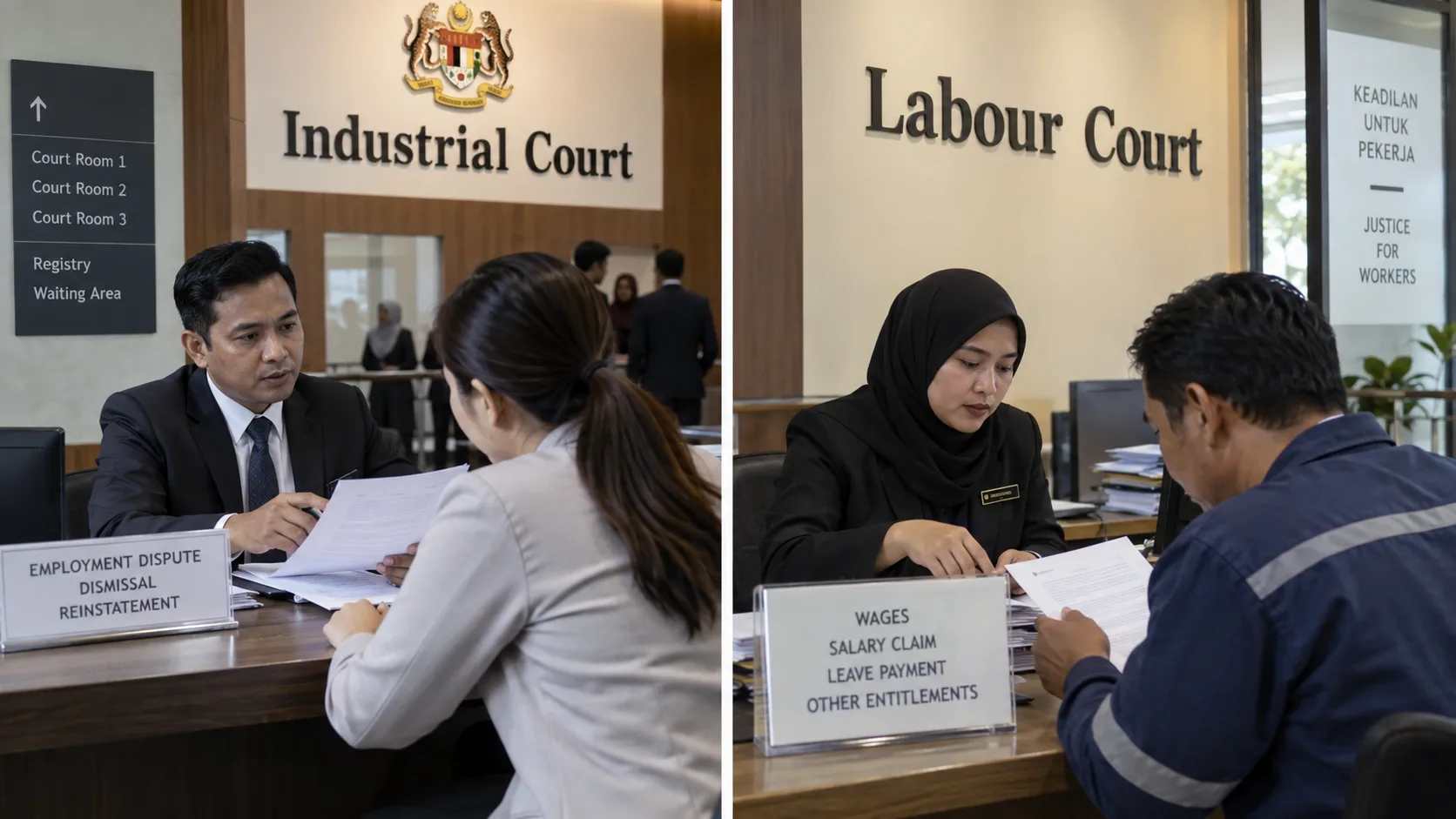
"Industrial Relations Court", "Industrial Court" and "Labour Court" are often used interchangeably. They are not the same thing.
The statutory name is the Industrial Court. It deals with industrial relations matters, including unfair dismissal.
The "Labour Court" is different. It refers to Labour Department proceedings under section 69 of the Employment Act 1955, mainly for monetary claims such as unpaid wages. Although the Labour Department uses the term "Labour Court", the Act does not establish a separate court by that name. Legally, it is an inquiry conducted by the Director General of Labour.
What is the Industrial Court?
The Industrial Court is established under section 21 of the Industrial Relations Act 1967. It is a specialist statutory tribunal, separate from the ordinary civil court system.
For individual employees, its best-known function is hearing unfair dismissal cases under section 20.
For a section 20(3) reference, the Court may sit without the usual employer and workman panel members. In Wong Yuen Hock v Syarikat Hong Leong Assurance Sdn Bhd, the Federal Court made clear that the absence of a proper domestic inquiry does not automatically make a dismissal unfair. The Industrial Court still determines whether the dismissal was justified.
How do you file an unfair dismissal claim?
An employee does not normally file directly in the Industrial Court.
The process starts under section 20 of the Industrial Relations Act:
- The employee considers that he or she has been dismissed without just cause or excuse.
- A written representation seeking reinstatement is filed with the Director General of Industrial Relations.
- It must generally be filed within 60 days of dismissal. If dismissal is with notice, it may be filed during the notice period or within 60 days after the notice expires.
- The Industrial Relations Department attempts conciliation.
- If the dispute is not settled, the Director General refers it to the Industrial Court.
The 2020 amendments transferred the referral power from the Minister to the Director General. The amended section 20(3) now requires the Director General to refer the representation where there is no likelihood of settlement.
The 60-day deadline is critical
The 60-day period is strict. Section 20(1A) says the Director General shall not entertain a late representation.
For example, if an employee is dismissed with immediate effect on 1 September 2026, negotiations with the employer do not automatically extend the filing period.
Filing before the dismissal takes effect can also be premature. A representation may also be deemed withdrawn if the employee fails to attend the required conferences without reasonable excuse.
This matters just as much where the employee left rather than being dismissed outright. A constructive dismissal claim, or an argument that a supposedly voluntary separation scheme was in truth forced, still runs on the same 60-day clock from the date the employment ended.
Probationers are also protected. In Khaliah Abbas v Pesaka Capital Corporation Sdn Bhd, the Court of Appeal recognised that a probationer may bring a claim for dismissal without just cause or excuse.
What can the Industrial Court award?
Reinstatement is the statutory remedy underlying a section 20 claim, although it is not granted in every successful case.
Where reinstatement is inappropriate, the Court may award compensation in lieu of reinstatement together with backwages.
Under the Second Schedule to the Industrial Relations Act, backwages are capped at 24 months for a confirmed employee and 12 months for a probationer. The Court must also consider post-dismissal earnings and contributory misconduct, while compensation for loss of future earnings is excluded.
Monetary awards can also carry interest from the thirty-first day after the award, subject to the provisions of section 30.
Can you bring a lawyer?
Not automatically.
Under section 27 of the Industrial Relations Act, an advocate may represent a party before the Industrial Court only with permission of the President or Chairman.
Employees may appear personally, and trade union representation is permitted in the circumstances provided by the Act.
Unfair dismissal and wrongful dismissal are different
This distinction is important because it can determine where the dispute should be filed.
An unfair dismissal claim is a statutory claim under section 20 of the Industrial Relations Act. It asks whether the employee was dismissed without just cause or excuse and may lead to reinstatement, backwages or compensation in lieu of reinstatement.
A wrongful dismissal claim is generally contractual. For example, an employer may terminate an employee without giving the notice or payment required by the employment contract. The usual remedy is damages rather than reinstatement.
In Bank Simpanan Nasional v Mohamad Rizuan Razak, the High Court emphasised the distinction between the civil court's contractual jurisdiction and the Industrial Court's unfair dismissal jurisdiction.
So what is the "Labour Court"?
The Labour Department currently describes section 69 proceedings as "Labour Court" proceedings.
Legally, however, section 69 gives the Director General of Labour power to inquire into and decide specified employment disputes.
In Austral Amalgamated Tin Bhd v Abdul Wahab Kopon & Ors, the High Court explained that the Labour Office inquiry is not a court proceeding and that the Employment Act does not establish a separate Labour Court.
This means the name "Labour Court" is commonly and officially used in practice, including by JTKSM, but the statutory mechanism itself is an inquiry conducted by the Director General.
What can you claim through the Labour Department?
Section 69 principally covers disputes involving wages or other cash payments due under a contract of service or employment legislation.
Common examples include unpaid salary, contractual allowances, wages in lieu of notice and other qualifying monetary entitlements.
The Labour Department also has jurisdiction over employment discrimination disputes under section 69F.
Certain statutory benefits are subject to the First Schedule of the Employment Act. JTKSM currently states that employees earning more than RM4,000 per month, unless an exception applies such as for manual employees, cannot claim certain overtime, rest-day, public-holiday, shift and termination benefits under the Act.
The process begins with a complaint to the Labour Department. The Director General may examine the complainant, summon the other party, hear evidence and issue an order.
Monetary orders may carry interest, and an unpaid order can be enforced through the mechanism provided by the Employment Act.
Sabah and Sarawak have their own labour legislation, so employees there should check the applicable ordinance.
What about retrenchment and resignation disputes?
The forum still depends on what is actually being claimed.
Where an employee says a retrenchment was not genuine, the complaint is in substance that the dismissal lacked just cause or excuse, which points to the section 20 route.
Where the dispute is instead about money left unpaid on the way out, such as outstanding wages or notice pay following a resignation the employer disputes, the Labour Department may be the more appropriate forum.
The same facts can therefore produce two different routes depending on the remedy sought.
Can an Industrial Court award be appealed?
Yes.
Section 33C of the Industrial Relations Act allows a person dissatisfied with an award made under section 30 to appeal to the High Court within 14 days from receipt of the award.
This is a very short period. An employer or employee considering an appeal should therefore obtain advice immediately after receiving the award.
Frequently Asked Questions
Is the Labour Court a real court in Malaysia?
The Labour Department uses the term "Labour Court", but the Employment Act provides for an inquiry by the Director General of Labour rather than creating a separate court institution.
Where do I file an unfair dismissal claim?
A representation is first filed with the Director General of Industrial Relations under section 20 of the Industrial Relations Act. If conciliation fails, the matter may be referred to the Industrial Court.
How long do I have to file an unfair dismissal claim?
Generally, 60 days from dismissal. Different timing rules apply where the employee is dismissed with notice.
Where do I claim unpaid salary?
Qualifying unpaid wage and monetary claims may generally be brought before the Labour Department under section 69 of the Employment Act.
Can a probationer claim unfair dismissal?
Yes. Probationary status does not remove protection against dismissal without just cause or excuse, although it can affect the remedies awarded.
Can I automatically bring a lawyer to the Industrial Court?
No. Representation by an advocate requires permission under section 27 of the Industrial Relations Act.
Can I appeal an Industrial Court award?
Yes. Section 33C provides a right of appeal to the High Court within 14 days from receipt of an award made under section 30.
Final takeaway
The Industrial Court and the Labour Department deal with different employment disputes.
If the complaint is that an employee was dismissed without just cause or excuse, the section 20 Industrial Relations Act route is usually relevant. If the dispute concerns unpaid wages or another qualifying monetary entitlement, the Labour Department may be the appropriate forum.
The correct route depends on the right being enforced, the remedy sought and the applicable deadline. Choosing the wrong forum may cause a strict statutory deadline to be missed.
Speak to JPP LAW
Justin, Poh & Partners, also known as JPP LAW, assists employees and employers with unfair dismissal, constructive dismissal, disciplinary proceedings, retrenchment, unpaid employment entitlements, employment contracts and other workplace disputes in Malaysia.
If you have been dismissed, are facing an employment claim, or are unsure whether a dispute belongs before the Industrial Court, Labour Department or civil courts, you may contact us to assess the legal position, applicable deadline and appropriate route.
Disclaimer: This article is for general information only and does not constitute legal advice. Employment disputes are fact-sensitive, and the applicable forum, limitation period and remedy depend on the circumstances of each case.
Your next step
Have a question about your own matter?
Speak directly with a partner about your situation. We will help you understand where you stand and what your options are, with no obligation.
Speak to a PartnerMore in Employment
Can My Employer Change My Job Scope or Transfer Me Without Consent in Malaysia?
Can your employer change your job scope or transfer you without consent in Malaysia? Learn when a transfer is lawful or amounts to constructive dismissal.
Read→Are Grab and Foodpanda Riders Employees in Malaysia?
Are Grab and Foodpanda riders employees or contractors in Malaysia? Learn how the Gig Workers Act 2025 changes their rights, pay and deactivation.
Read→Can You Leave Immediately After Resigning in Malaysia?
Can you resign and leave immediately in Malaysia? Learn how notice periods, payment in lieu of notice and constructive dismissal affect when you can leave.
Read→