
Employment
Are Grab and Foodpanda Riders Employees in Malaysia?
Written by Justin Yap, Partner
Last reviewed 22 September 2026 · 6 min read
On this page
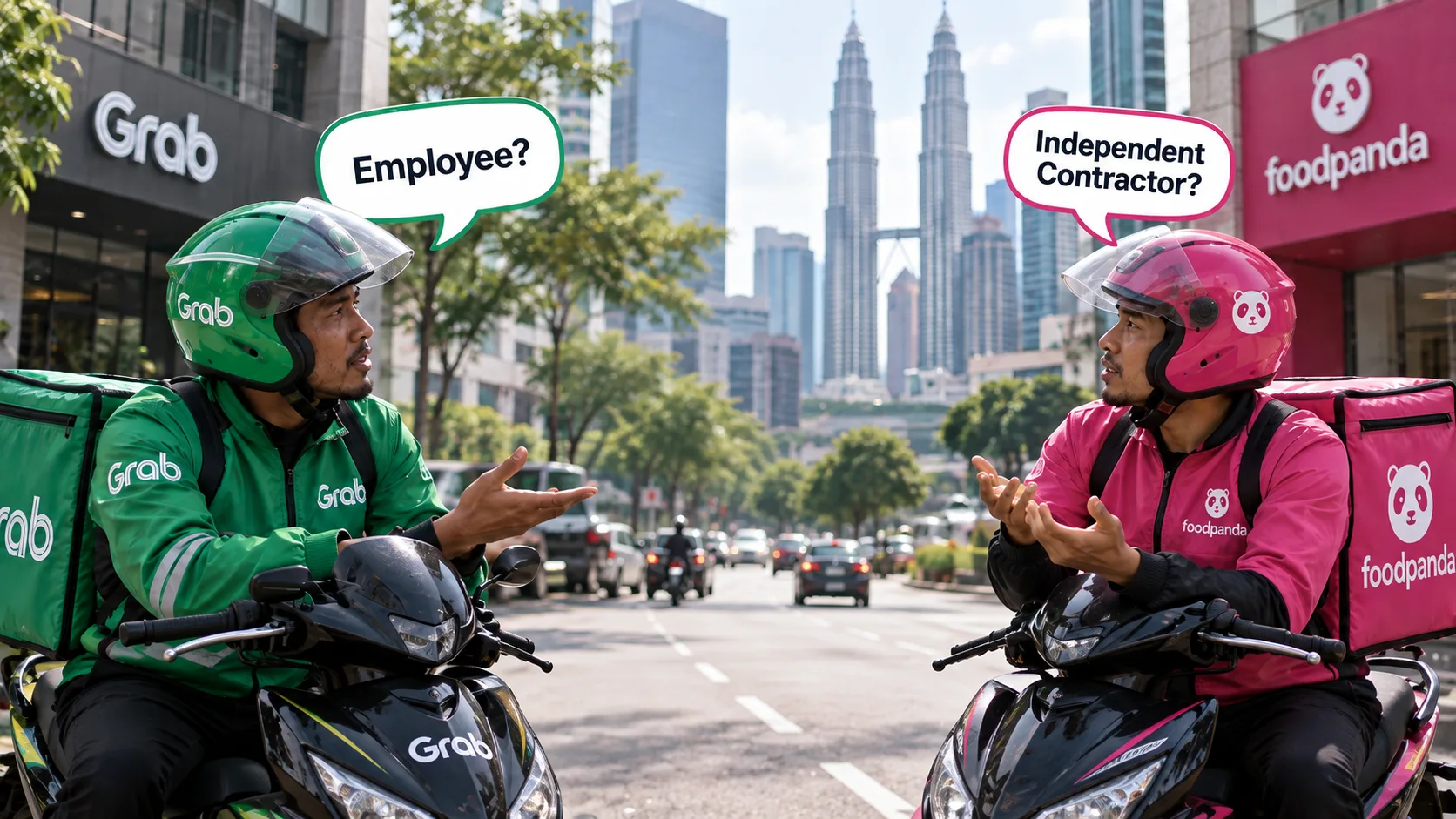
Grab drivers and food-delivery riders are not automatically treated as employees under Malaysian employment law. Historically, Malaysian courts have treated e-hailing drivers as independent contractors rather than "workmen" entitled to bring unfair dismissal claims in the Industrial Court.
That position has now become more nuanced. Since 31 March 2026, the Gig Workers Act 2025 (Act 872) gives qualifying platform workers their own statutory rights, including protection against termination without just cause or excuse, rights concerning earnings and deductions, procedures for account deactivation, social security protection and access to the new Gig Workers Tribunal.
Malaysia has therefore moved towards a separate legal framework for gig workers rather than simply treating every rider as either a traditional employee or an ordinary independent contractor.
Why does employee status matter?
The distinction between an employee and an independent contractor affects the legal rights available when something goes wrong.
An employee working under a contract of service may fall within the Employment Act 1955 and may qualify as a "workman" under the Industrial Relations Act 1967. This can give the employee rights involving matters such as wages, leave, working hours and unfair dismissal.
An independent contractor normally works under a contract for services and historically relied mainly on the commercial agreement with the person engaging them.
Platform work created difficulty because it does not fit neatly into either category. Riders may decide when to log in and may use their own motorcycles or cars, but the platform can still determine fares, allocate jobs, monitor ratings and deactivate access to the app.
That tension has led many countries to reconsider how platform workers should be classified.
What did Malaysian courts say about Grab drivers?
The main Malaysian case is Loh Guet Ching v Menteri Sumber Manusia & Ors, involving a Grab driver whose access to the platform was terminated.
She attempted to bring an unfair dismissal representation under section 20 of the Industrial Relations Act 1967.
The Malaysian courts rejected that route.
The Court of Appeal held in 2023 that the driver was not a "workman" under the Industrial Relations Act. Among the factors considered were that she used her own vehicle, was not paid a salary by Grab, did not receive EPF or SOCSO contributions from Grab and was able to decide when to use the platform. Grab instead charged commission for use of its platform.
The Federal Court subsequently refused leave to appeal in July 2024. Importantly, the Federal Court did not itself conduct a fresh substantive determination that every platform worker in Malaysia is an independent contractor. The Court of Appeal decision nevertheless remained standing.
The case therefore established an important position for e-hailing drivers, but it should not be read as meaning that every person who works through an app can never be an employee.
The contract label is not always the final answer
Outside the specific gig-worker framework, Malaysian employment law continues to look at the real relationship between the parties.
The Federal Court recently reinforced this in Acexide Technology Sdn Bhd & Anor v Chang Heng Keong & Another Appeal [2026] 5 MLRA 455.
The Court explained that employment status must be considered holistically and in substance. Control remains important, but no single factor automatically decides the issue. The absence of fixed hours, a written employment contract or a traditional workplace does not necessarily mean that employment cannot exist.
This means calling someone a "partner", "freelancer" or "independent contractor" does not settle the legal position if the actual arrangement operates as employment.
However, the Gig Workers Act has now created a more specific framework for genuine gig relationships.
What changed under the Gig Workers Act 2025?
The Gig Workers Act 2025 came into force on 31 March 2026.
The Act defines a gig worker to include a Malaysian citizen or permanent resident who enters into a service agreement with a platform provider to provide services in Malaysia in return for earnings.
Importantly, the Act specifically defines a "service agreement" so that it does not include a contract of service under the Employment Act or a contract of employment under the Industrial Relations Act.
That tells us something important about the structure of the new law.
Parliament did not simply declare all platform workers to be employees. Instead, it created a separate category with its own protections.
What rights do riders now have?
A genuine gig worker may still not be an employee, but this no longer means the platform relationship is governed only by whatever terms appear in the app.
The Act requires the service agreement to identify matters including the services to be provided, the parties' obligations, earnings rates and payment arrangements.
Gig workers also have statutory rights to be informed of their earnings before accepting a service and to receive payment according to the agreed terms. If the agreement does not state when earnings must be paid, the Act provides a 7-day payment period after completion of the service.
Deductions from earnings, tips and gratuities are also restricted.
The Act goes further for platform workers by addressing algorithmic management. Platforms must provide information about automated systems used to monitor or evaluate workers and automated systems used to make decisions concerning matters such as work assignments and working conditions. Workers must also have access to a non-automated review mechanism.
This is significant because many important decisions affecting riders are made through the app rather than by a human manager.
Can Grab or Foodpanda simply deactivate a rider?
The platform can deactivate access in circumstances permitted by the Act, but the process is now regulated.
Section 14 allows a platform provider to deactivate a gig worker where this is justified under the service agreement or where misconduct is alleged.
For an inquiry, access may be modified or suspended for up to 14 days, and the worker must receive written notice.
Before the platform decides to terminate access or continue a suspension on misconduct grounds, the worker must be given a right to be heard.
If the inquiry finds no proper basis for deactivation, the platform must reactivate the account and pay the worker an amount calculated at half of the worker's average daily earnings for the relevant suspension period.
If adverse action is taken, the platform must provide a written explanation.
This is not technically the same as an employee bringing an unfair dismissal claim under section 20 of the Industrial Relations Act. However, it gives gig workers a statutory form of protection against arbitrary termination of their access to the platform, and it sits closer to how constructive dismissal is assessed than to an ordinary contractual dispute.
Where does a gig worker bring a dispute?
The new Act creates a dispute-resolution system specifically for gig workers.
Depending on the dispute, the process may begin with the platform's internal grievance procedure. A worker who remains dissatisfied may then lodge a complaint for conciliation.
If the dispute cannot be resolved, it can be referred to the Gig Workers Tribunal.
The Tribunal has substantial powers. It may order payment of outstanding earnings, refund wrongful deductions, award compensation for loss or damage, require compliance with the service agreement and, importantly for platform workers, order that a worker be allowed to perform services or regain access to the platform.
A Tribunal award is binding and is treated as an order of the Sessions Court for enforcement purposes. An aggrieved party may appeal to the High Court within 14 days.
For a genuine gig worker, this Tribunal is therefore likely to be far more relevant than the Industrial Court.
What about minimum wage, EPF and SOCSO?
Gig workers should not assume that all employee entitlements automatically apply to them.
The Gig Workers Act does not simply convert gig earnings into ordinary employee wages. The Human Resources Ministry has specifically explained that Malaysia's general minimum wage should not automatically be treated as the minimum earnings rate for gig workers. The Act instead establishes a Gig Consultative Council which may recommend minimum earnings rates and formulas designed for different gig sectors.
Platform providers are also required to facilitate social security protection through PERKESO's Self-Employment Social Security Scheme, including registration and mandatory deductions and remittance of contributions.
This is another example of Malaysia creating protections specifically for gig work without simply treating the relationship as conventional employment.
What is happening overseas?
Malaysia is part of a wider global shift towards greater protection for platform workers, but different countries have taken different approaches.
In the United Kingdom, the Supreme Court held in Uber BV v Aslam [2021] UKSC 5 that Uber drivers qualified as "workers". That is a UK legal category which gives rights such as minimum wage and paid annual leave, although it is not identical to full employee status.
The European Union has moved further towards addressing possible misclassification. Its Platform Work Directive requires Member States to introduce procedures that make it easier to establish employment status where the facts show direction and control, while also regulating automated monitoring and decision-making by platforms.
Singapore has taken an approach closer to Malaysia. Since 2025, Singapore has recognised platform workers as a separate legal category, distinct from both employees and ordinary self-employed persons, while providing rights involving CPF contributions, work injury compensation and collective representation.
The broader international trend is therefore not necessarily to declare every rider an employee. It is to reduce the gap in protection that historically existed when platform workers were classified simply as independent contractors.
What does this mean for a rider today?
A rider whose account is suspended or terminated should first identify whether the Gig Workers Act applies and obtain the service agreement and written reason for the platform's decision.
Keep screenshots of the deactivation notice, earnings records, ratings, messages, customer complaints and any explanation provided through the platform.
The Act's conciliation regulations impose time limits on gig-worker complaints, including a 60-day period for filing specified disputes with the Conciliator, so the matter should not be left unattended.
If the real working arrangement goes beyond gig work and resembles genuine employment, the question of employee status may also need to be considered separately based on the actual facts.
Frequently Asked Questions
Are Grab drivers employees in Malaysia?
Not automatically. The Court of Appeal has previously held that a Grab e-hailing driver was an independent contractor rather than a workman under the Industrial Relations Act. Since 2026, qualifying drivers also have separate rights under the Gig Workers Act 2025.
Are Foodpanda riders protected by employment law?
A qualifying platform delivery rider may fall within the Gig Workers Act even if the rider is not legally an employee. The specific contractual and working arrangement must still be considered.
Can a platform terminate a rider without giving a reason?
The Gig Workers Act now regulates deactivation and provides rights including written notice, an inquiry in relevant cases, a right to be heard and a written explanation for certain decisions.
Can a gig worker file an unfair dismissal claim?
A genuine gig worker does not automatically use the Industrial Relations Act unfair dismissal route available to a "workman". The Gig Workers Act now provides its own grievance, conciliation and Tribunal process.
Final takeaway
Malaysia no longer treats the gig economy as a simple choice between being an employee or having no labour protection at all.
Grab drivers, delivery riders and other qualifying platform workers may remain outside traditional employee status, but the Gig Workers Act 2025 now gives them statutory rights concerning earnings, deactivation, algorithmic decision-making, social security and dispute resolution.
At the same time, the distinction between employment and independent contracting has not disappeared. Where the actual relationship is genuinely one of employment, Malaysian courts will still examine the substance of the arrangement rather than relying only on the title placed in the contract.
Speak to JPP LAW
Justin, Poh & Partners, also known as JPP LAW, assists individuals and businesses with employment status disputes, gig-worker disputes, termination and deactivation issues, independent contractor arrangements, unfair dismissal and related employment matters in Malaysia.
If your platform account has been suspended or terminated, or your business needs to determine whether workers should be engaged as employees, contractors or gig workers, you may contact us to assess the contractual relationship and applicable legal framework.
Disclaimer: This article is for general information only and does not constitute legal advice. Platform-worker status depends on the service agreement, actual working arrangements, degree of control, nature of the platform and the applicable legislation.
Your next step
Have a question about your own matter?
Speak directly with a partner about your situation. We will help you understand where you stand and what your options are, with no obligation.
Speak to a PartnerMore in Employment
Can My Employer Change My Job Scope or Transfer Me Without Consent in Malaysia?
Can your employer change your job scope or transfer you without consent in Malaysia? Learn when a transfer is lawful or amounts to constructive dismissal.
Read→Industrial Court vs Labour Court in Malaysia: What Is the Difference and Where Should You File?
Industrial Court or Labour Court in Malaysia? Learn where to file unfair dismissal and unpaid salary claims, and the deadlines that apply.
Read→Can You Leave Immediately After Resigning in Malaysia?
Can you resign and leave immediately in Malaysia? Learn how notice periods, payment in lieu of notice and constructive dismissal affect when you can leave.
Read→