
Construction
CIPAA vs Arbitration vs Litigation in Malaysia: Can They Run at the Same Time?
Written by Justin Yap, Partner
Last reviewed 12 August 2026 · 6 min read
On this page
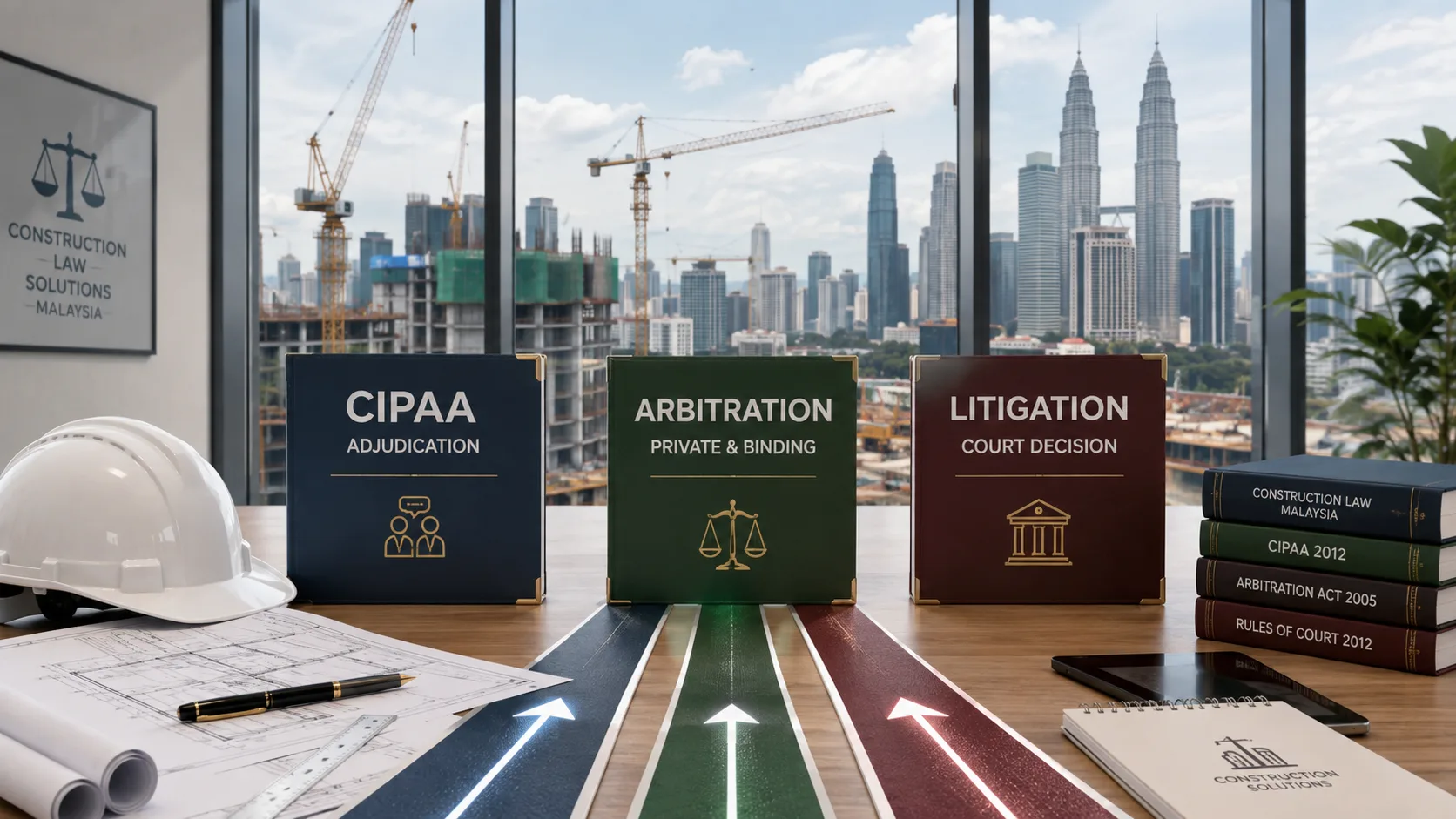
A construction payment dispute does not have to stay in one forum. In Malaysia, the same payment dispute may go through CIPAA adjudication even while arbitration or court proceedings are ongoing.
CIPAA was designed to deal with payment quickly while preserving the parties' right to obtain a final decision elsewhere. The key provision is section 37 of the Construction Industry Payment and Adjudication Act 2012.
Section 37 allows parallel proceedings
Section 37 provides that a payment dispute under a construction contract may be referred concurrently to adjudication, arbitration or the court.
Starting arbitration or a court case does not automatically stop an adjudication that is already underway.
The adjudication only comes to an end if the same dispute is settled by written agreement between the parties or finally decided by arbitration or the court.
The practical position is therefore straightforward. A party does not necessarily have to choose only one route from the beginning.
Why does CIPAA work this way?
CIPAA focuses heavily on cash flow.
Construction disputes can take years to resolve finally. During that period, contractors and subcontractors still need to pay workers, suppliers, consultants and other project expenses.
The Federal Court in Martego Sdn Bhd v Arkitek Meor & Chew Sdn Bhd & Another Appeal [2019] 5 MLRA 584 recognised the importance of cash flow in the construction industry and the role of adjudication as a speedy payment mechanism.
This explains the concept of temporary finality.
A CIPAA decision is binding and enforceable for the time being, but it does not necessarily represent the final determination of the parties' underlying rights. Those rights can still be decided later through arbitration or litigation.
CIPAA, arbitration and litigation compared
| Feature | CIPAA adjudication | Arbitration | Litigation |
|---|---|---|---|
| Main purpose | Fast resolution of construction payment disputes | Final resolution of contractual disputes | Final resolution through the courts |
| How it starts | Statutory right under CIPAA | Usually requires an arbitration agreement | Proceedings filed in court |
| Typical timeframe | About 95 working days, roughly 4 to 5 months, from payment claim to decision | Commonly 1 to 2+ years, depending on complexity and tribunal availability | Commonly 2 to 5+ years, potentially longer if there are appeals |
| Scope | Mainly payment for work done or services rendered | Can cover the wider contractual dispute | Can cover the wider legal dispute |
| Finality | Temporarily binding | Generally final and binding, subject to limited challenge | Final subject to appeal |
| Enforcement | May be enforced as a High Court judgment under section 28 CIPAA | Arbitral award may be recognised and enforced through the court | Judgment enforced through normal court procedures |
The timeframes for arbitration and litigation are only general estimates. They vary considerably depending on the complexity of the dispute, number of witnesses, applications made by the parties and whether appeals are pursued.
CIPAA is different because much of its procedure operates within short statutory deadlines.
What if a court case was filed first?
The existence of an earlier court case does not automatically prevent CIPAA adjudication.
In Mudajaya Corporation Bhd v KWSL Builders Sdn Bhd & Other Cases [2022] MLRHU 1663, KWSL had obtained adjudication decisions even though Mudajaya had already commenced civil proceedings concerning the project.
The High Court rejected the argument that the earlier lawsuit prevented adjudication. Section 37 expressly allows the processes to operate concurrently.
Filing a lawsuit first therefore does not reserve the payment dispute exclusively for the court.
What if arbitration has already started?
The same principle applies where arbitration is already underway.
In Tenaga Nasional Bhd v Malaysian Resources Corporation Bhd & Other Cases [2024] MLRHU 480, the court rejected an argument that adjudication could not subsequently be commenced because arbitration had already started.
The important question is not simply which proceeding began first.
Until the same dispute has been finally determined by arbitration or the court, section 37 allows CIPAA adjudication to perform its separate payment function.
Can an arbitration clause stop CIPAA?
No, an arbitration clause does not ordinarily remove a party's statutory right to use CIPAA.
Construction contracts frequently contain clauses requiring disputes to be referred to arbitration. Those clauses remain relevant to the final resolution of the contractual dispute, but they do not automatically prevent an eligible payment claim from being adjudicated.
In Aspen Vision Builders Sdn Bhd v Proventus Bina Sdn Bhd [2025] MLRHU 2714, the High Court considered an argument that a contractual arbitration mechanism prevented adjudication. The contractual arrangement could not be used to defeat the statutory right provided by CIPAA.
Similarly, commencing CIPAA while arbitration is ongoing does not by itself amount to an abuse of process.
The two mechanisms serve different purposes.
When does the adjudication have to stop?
Concurrency is not unlimited.
Section 37(3) identifies the point at which adjudication must give way.
If the parties settle the same dispute through a written agreement, the adjudication ends.
The same applies once the dispute has actually been decided by arbitration or the court.
There is therefore an important difference between a pending proceeding and a final determination.
The mere existence of a lawsuit or arbitration is generally not enough. A final decision on the same dispute is different.
What happens after someone wins the CIPAA adjudication?
A successful party may apply under section 28 CIPAA to enforce the adjudication decision as if it were a judgment or order of the High Court.
The losing party cannot simply refuse to comply because arbitration or litigation is still ongoing. Where the adjudicated sum stays unpaid, section 29 may also allow the successful party to suspend work or reduce progress.
CIPAA provides limited mechanisms to challenge the decision.
Section 15 permits an adjudication decision to be set aside on specific grounds, including where the adjudicator acted in excess of jurisdiction or there was a denial of natural justice.
This is not a full appeal on the merits. A party cannot obtain a rehearing simply because it disagrees with the adjudicator's conclusion.
Can payment be stayed while arbitration or litigation continues?
A party may apply for a stay under section 16 CIPAA in certain circumstances, including where the subject matter of the adjudication decision is pending final determination by arbitration or the court.
But pending arbitration alone does not automatically justify a stay.
In View Esteem Sdn Bhd v Bina Puri Holdings Bhd [2018] 1 MLRA 460, the Federal Court explained that the court must consider the circumstances of the case when deciding whether a stay should be granted.
The Court of Appeal in ASM Development (KL) Sdn Bhd v Econpile (M) Sdn Bhd & Other Appeals [2023] 1 MLRA 646 further illustrates how those circumstances can matter.
There, the court considered factors including a substantial counterclaim, the overlap with the arbitration and concerns about the successful adjudication party's ability to repay the money if the arbitration later produced a different result.
The important point is that a stay is not automatic merely because another dispute resolution process exists.
Example: one dispute, two processes
Assume a main contractor owes a subcontractor RM2 million for completed works.
The main contractor says the subcontractor caused concurrent delays and defective works worth RM5 million. Their contract contains an arbitration clause, and arbitration begins over the wider dispute.
The subcontractor may still use CIPAA to pursue the RM2 million payment claim.
If the subcontractor succeeds, the adjudication decision can be binding and enforceable even though the arbitration continues.
The arbitration may later examine the entire contractual relationship, including delays, defects, damages and other claims. If the arbitrator eventually reaches a different final position, the arbitral award determines the parties' ultimate rights.
CIPAA addresses the immediate payment issue. Arbitration deals with the final accounting between the parties.
Which route should you use?
It depends on the dispute.
If the immediate problem is non-payment for construction work or consultancy services, CIPAA may provide the quickest route to a binding decision.
If the dispute involves substantial damages, termination, defects, delay claims or wider contractual issues, arbitration or litigation may still be necessary.
Sometimes both routes make sense.
A contractor may use CIPAA to address an immediate cash-flow problem while preserving its wider claims for arbitration. A respondent facing a CIPAA claim may continue pursuing its damages claim through arbitration or court proceedings.
The correct strategy depends on what each process can actually decide.
Frequently Asked Questions
Can I start CIPAA if my contract says disputes must go to arbitration?
Yes, provided the payment dispute falls within CIPAA. An arbitration clause does not ordinarily remove the statutory right to adjudicate.
Can CIPAA continue if a court case has already been filed?
Yes. Section 37 permits concurrent proceedings. A pending court case does not automatically stop adjudication.
Which decision ultimately controls?
A CIPAA decision is temporarily binding. If the same dispute is later finally determined by arbitration or the court, that final determination governs the parties' ultimate rights.
Can I refuse to pay a CIPAA decision because arbitration is ongoing?
No, not simply because arbitration is pending. Unless the adjudication decision is stayed, set aside or otherwise ceases to be binding under CIPAA, it remains enforceable.
Final takeaway
CIPAA, arbitration and litigation are not necessarily competing choices.
Section 37 allows a construction payment dispute to proceed through CIPAA while arbitration or court proceedings continue in parallel. This allows an unpaid party to pursue payment quickly without giving up the right to have the wider dispute finally determined later.
The distinction is practical. CIPAA addresses immediate payment. Arbitration and litigation determine the parties' final rights.
For businesses involved in construction disputes, understanding how these processes interact can make a significant difference to both cash flow and overall dispute strategy.
Speak to JPP LAW
Justin, Poh & Partners, also known as JPP LAW, assists employers, contractors, subcontractors and consultants with CIPAA adjudication, arbitration and construction litigation in Malaysia, including enforcement, setting-aside and stay applications.
If you are dealing with a construction payment dispute and need to decide whether to adjudicate, arbitrate, litigate or pursue proceedings concurrently, you may contact us to discuss the matter.
Disclaimer: This article is for general information only and does not constitute legal advice. The appropriate dispute resolution strategy depends on the construction contract, nature of the payment dispute, existing proceedings and specific circumstances of each case. You should seek advice based on your specific circumstances.
Your next step
Have a question about your own matter?
Speak directly with a partner about your situation. We will help you understand where you stand and what your options are, with no obligation.
Speak to a PartnerMore in Construction
Back-to-Back Construction Contracts in Malaysia: What They Mean and What to Watch For
What is a back-to-back construction contract in Malaysia? Learn how obligations flow to subcontracts, key risks, CIPAA payment rules and clauses to check.
Read→Types of Construction Contracts in Malaysia: PAM, PWD, FIDIC, CIDB & IEM Explained
PAM, PWD or FIDIC? Compare construction contracts used in Malaysia, their project fit, design responsibility, risk allocation, CIDB and IEM alternatives.
Read→Wrongful Termination in Construction: How to Respond and What Can You Claim?
Was your construction contract terminated? Learn how to check if the termination was valid, what to do now and what damages you can claim.
Read→