
Construction
CIPAA Adjudication Timeline in Malaysia: From Payment Claim to Decision
Written by Justin Yap, Partner
Last reviewed 12 August 2026 · 6 min read
On this page
CIPAA adjudication is designed to move quickly. From the first payment claim to the adjudication decision, the process runs on statutory deadlines, and missing some of those deadlines can undermine the entire adjudication.
That speed is one of CIPAA's main advantages, but the clock must be watched carefully.
Step 1: Payment claim under section 5
The process starts when an unpaid party serves a written payment claim on the non-paying party.
Section 5 requires the claim to state the amount claimed and due date, identify the cause of action and relevant contractual provision, describe the work or services, and state that the claim is made under CIPAA.
The payment must already be due.
In Ideal City Development Sdn Bhd v PWC Bina Sdn Bhd & Other Appeals [2019] 1 MLRA 275, the payment claim was served before the contractual due date. The Court of Appeal held that the claimant could not yet be treated as an unpaid party for that amount.
CIPAA is not meant for payments that may only become due in the future.
Step 2: Payment response within 10 working days
Section 6 gives the non-paying party 10 working days from receipt of the payment claim to serve a payment response.
The response should identify what is admitted, disputed and why, and it is the stage at which set-offs and backcharges are normally raised. If none is served, section 6(4) deems the whole claim disputed.
A respondent who misses this stage does not automatically lose every defence. In View Esteem Sdn Bhd v Bina Puri Holdings Bhd [2018] 2 MLJ 22, the Federal Court held that defences may still be raised in the adjudication response even if omitted earlier. Responding on time is still the safer course.
Step 3: Notice of adjudication
After the 10-working-day payment response period has fully expired, the dispute may be referred to adjudication under sections 7 and 8.
Do not serve the notice early.
In Tenaga Nasional Berhad v Blocklink (M) Sdn Bhd & Another Case [2022] MLRHU 1879, the notice was served on the final day of the response period. It was one day premature, and the adjudication decision was set aside.
Step 4: Appointment of the adjudicator
The parties may agree on an adjudicator. If they do not, the Director of the Asian International Arbitration Centre may make the appointment under CIPAA.
Once the adjudicator accepts the appointment, the next statutory deadline begins.
Step 5: Adjudication claim within 10 working days
Under section 9, the claimant has 10 working days from receipt of the adjudicator's acceptance to serve the adjudication claim.
This is the claimant's full case, setting out the dispute, remedy sought and supporting documents.
Step 6: Adjudication response within 10 working days
Section 10 gives the respondent 10 working days from receipt of the adjudication claim to serve the adjudication response.
If no response is served, the adjudication can continue after the deadline. An oral hearing is not compulsory. In Permintex JSK Resources Sdn Bhd v Follitile (M) Sdn Bhd [2017] MLRHU 152, the High Court recognised that an adjudicator may decide on written material where the parties were given a fair opportunity to present their case.
Step 7: Adjudication reply within 5 working days
Section 11 gives the claimant 5 working days after receiving the adjudication response to serve a reply.
There is no automatic right to a further rejoinder. In MRCB Builders Sdn Bhd v Wazam Ventures Sdn Bhd & Another Case [2020] 5 MLRH 138, the High Court recognised that refusing a rejoinder does not necessarily breach natural justice.
Step 8: The 45-working-day decision period
Section 12 requires the adjudicator to decide the dispute and deliver the decision within 45 working days from service of the adjudication response or reply, whichever is later. If no response is received, the 45 working days run from expiry of the response period. The parties may agree to a longer period.
The definition of "working day" matters. Section 4 ties the calculation to the state or territory where the construction site is located.
In Encorp Iskandar Development Sdn Bhd v Konsortium Ipmines Merz Sdn Bhd [2023] 6 MLRA 345, the Court of Appeal dealt with a Johor project. The adjudicator used the wrong working-week basis, causing the decision to be one day late. The decision was void.
Parties should calculate the deadline themselves.
A late decision is a void decision
Section 12(3) is clear. An adjudication decision not made within the prescribed period is void.
Even one day can be fatal.
In Skyworld Development Sdn Bhd v Zalam Corporation Sdn Bhd & Other Cases [2019] 3 MLRH 143, a decision made one day late was held void.
The courts have also distinguished between making the decision and releasing it. In Utama Motor Workshop (S) Sdn Bhd v Besicon Engineering Works Sdn Bhd [2022] MLRHU 1131, the High Court stressed that the adjudicator must make the decision within time.
Section 19(5) may allow release of a completed decision to be withheld pending fees, but it does not extend the time to make it. Celtex Supreme Sdn Bhd v Mega Bina Garisan Sdn Bhd [2021] MLRHU 530 supports the same distinction.
Only the parties can agree to more time
Section 12(2)(c) allows the decision period to be extended if the parties agree.
The adjudicator cannot extend the deadline unilaterally.
MRCB Builders Sdn Bhd v SMM Resources Sdn Bhd & Another Case [2021] MLRHU 1084 and Encorp Iskandar reinforce this rule.
Silence should not be treated casually as agreement. If more time is agreed, record the extension clearly in writing.
What happens if the decision is late?
A late decision is not merely a procedural irregularity. It is void under section 12(3).
That can defeat enforcement and support a setting-aside application. In Utama Motor, the adjudicator was also ordered to refund fees and expenses.
A narrow exception: statutory suspension
The 45-day rule is strict, but an external legal prohibition may affect the running of proceedings.
In Damai City Sdn Bhd v Grand Dynamic Builders Sdn Bhd & Another Case [2025] MLRHU 1362, the timeline was affected by statutory and court-ordered restraints arising from corporate proceedings.
This is different from ordinary delay. An adjudicator being busy does not suspend the clock. A genuine statutory moratorium may.
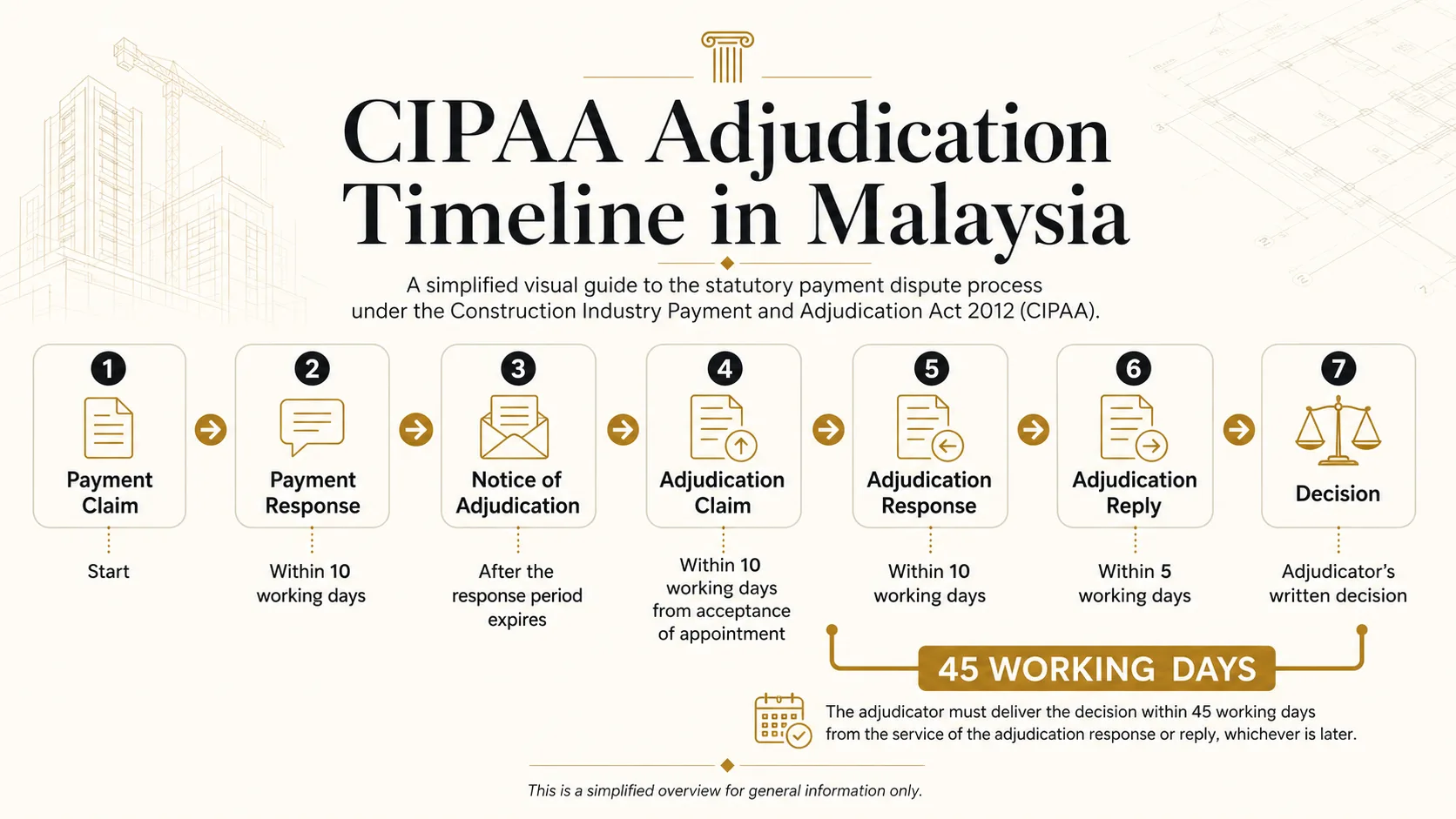
The timeline at a glance
- Payment claim: the amount must already be due.
- Payment response: 10 working days.
- Notice of adjudication: only after the response period expires.
- Adjudication claim: 10 working days after acceptance of the adjudicator.
- Adjudication response: 10 working days.
- Adjudication reply: 5 working days.
- Decision: generally 45 working days from the response or reply, whichever is later.
Both sides should keep their own deadline calendar, check the site location, weekends and public holidays, and preserve proof of service.
Frequently Asked Questions
How long does a CIPAA adjudication take?
CIPAA is designed to move quickly. The core pleading stages use short 5 or 10 working-day periods, followed by the adjudicator's 45-working-day decision period.
What happens if there is no payment response?
The whole payment claim is deemed disputed under section 6(4). The claimant may proceed after the response period expires. The respondent may still be able to raise defences in the later adjudication response.
Can the adjudicator extend the 45-day deadline?
Not alone. A further period under section 12(2)(c) requires agreement by the parties.
Is a decision one day late still valid?
No, if the section 12 deadline has genuinely expired and there is no valid extension or legal suspension. Malaysian courts have treated a one-day delay as fatal.
Final takeaway
CIPAA works because it is fast, but that speed comes with strict timing rules.
The payment must already be due before the section 5 claim is served. The payment response period must fully expire before adjudication begins. The adjudication claim, response and reply then move through short statutory windows before the 45-working-day decision period.
The most serious timing mistake can occur at the end. A decision made outside the statutory period is void.
For both claimants and respondents, the safest approach is to calculate every deadline independently and treat the CIPAA timetable as part of the legal case itself.
Speak to JPP LAW
Justin, Poh & Partners, also known as JPP LAW, assists employers, contractors, subcontractors and consultants with CIPAA payment claims, adjudication proceedings, jurisdictional challenges, enforcement and setting-aside applications in Malaysia.
If you are preparing for a CIPAA adjudication or need to check whether a notice, response or adjudication decision was made within time, you may contact us to discuss the matter.
Disclaimer: This article is for general information only and does not constitute legal advice. CIPAA timelines depend on the contract, site location, service dates, public holidays, procedural history and any applicable court or statutory orders. You should seek advice based on your specific circumstances.
Your next step
Have a question about your own matter?
Speak directly with a partner about your situation. We will help you understand where you stand and what your options are, with no obligation.
Speak to a PartnerMore in Construction
Back-to-Back Construction Contracts in Malaysia: What They Mean and What to Watch For
What is a back-to-back construction contract in Malaysia? Learn how obligations flow to subcontracts, key risks, CIPAA payment rules and clauses to check.
Read→Types of Construction Contracts in Malaysia: PAM, PWD, FIDIC, CIDB & IEM Explained
PAM, PWD or FIDIC? Compare construction contracts used in Malaysia, their project fit, design responsibility, risk allocation, CIDB and IEM alternatives.
Read→Wrongful Termination in Construction: How to Respond and What Can You Claim?
Was your construction contract terminated? Learn how to check if the termination was valid, what to do now and what damages you can claim.
Read→