
Construction
Concurrent Delay in Construction: Who Pays When Both Sides Cause Delay?
Written by Justin Yap, Partner
Last reviewed 17 September 2026 · 6 min read
On this page
When both the employer and contractor contribute to delay, there is no single rule that automatically decides who "wins". The result depends on what is being claimed: an extension of time, liquidated damages, prolongation costs or an argument that the contractual completion date no longer applies.
The starting point is always the construction contract, followed by evidence showing which events actually affected the completion date.
What is concurrent delay?
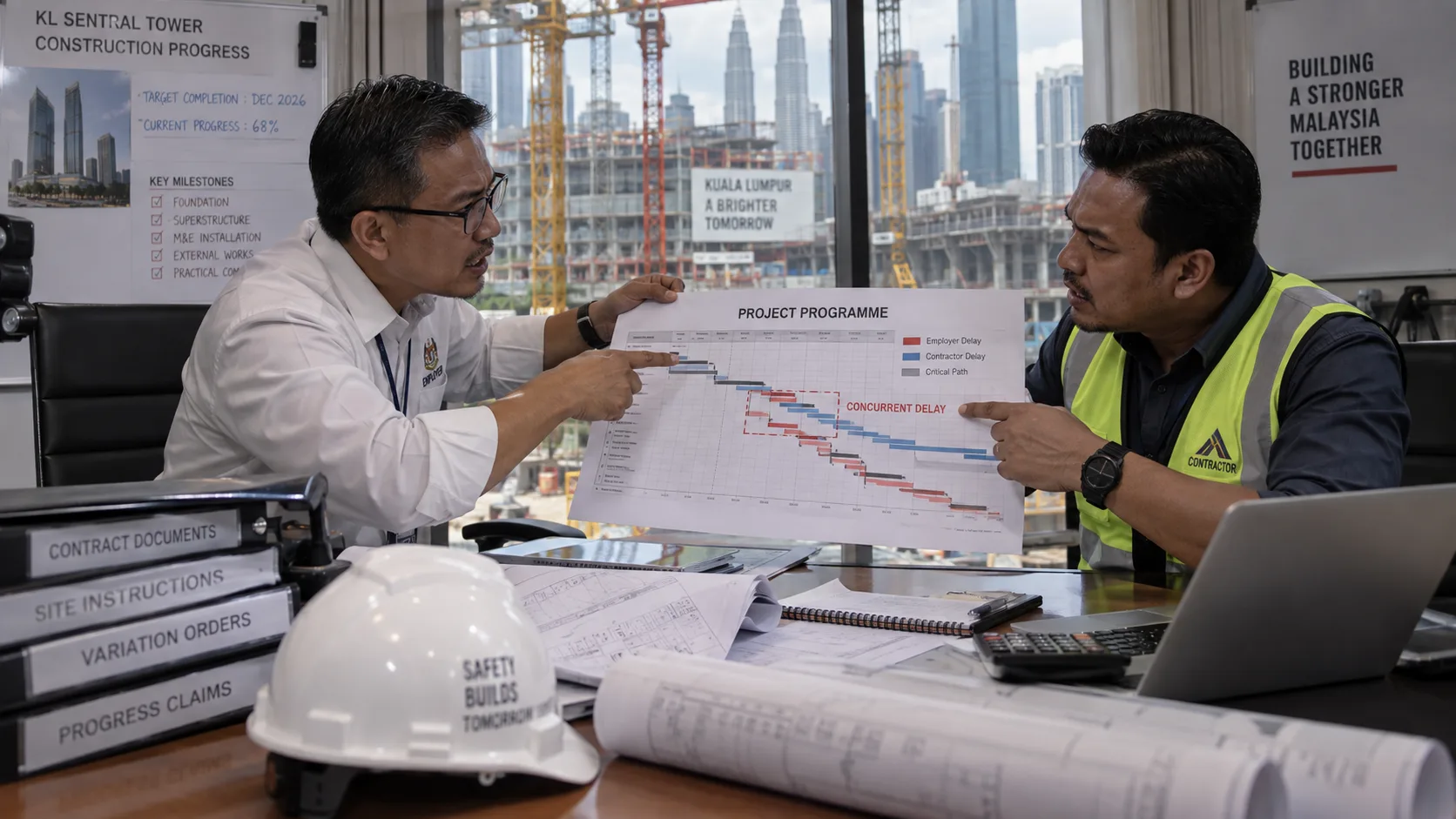
Concurrent delay generally arises where an employer-risk delay and a contractor-risk delay operate at the same time, and both independently affect completion.
For example, assume the employer is two weeks late in issuing an important structural drawing. During the same two weeks, the contractor is also unable to proceed because essential materials that it was responsible for ordering have not arrived.
If either problem existed on its own, the project would still have been delayed.
That is what makes concurrency difficult. It is not enough to show that both parties made mistakes during the same general period. The two events must actually affect the progress of critical work and contribute to the same delay to completion.
The first question: does the contractor still get an EOT?
Potentially, yes.
Malaysian authority recognises that a contractor may still be entitled to additional time where an employer-risk event and a contractor-risk event operate concurrently, depending on the wording of the contract.
In RC Asia Engineering Sdn Bhd v Lion Pacific Sdn Bhd [2021] MLRHU 1349, the High Court considered concurrent delays and accepted that an employer-caused event can still support additional time even where contractor delay also exists.
The important qualification is that the contractor must still comply with the EOT provisions in the contract.
This was reinforced by the Court of Appeal in Yuk Tung Construction Sdn Bhd v Daya CMT Sdn Bhd [2020] MLRAU 211. The contractor could not avoid the agreed EOT machinery merely by arguing that the employer had contributed to the delay. The contractual notice requirements still had to be followed.
Concurrent delay therefore does not rescue a contractor that failed to submit a required EOT notice.
Only delay to the critical path matters
Not every delay occurring on a project affects the completion date.
The "critical path" is simply the chain of activities that determines when the project can finish. If one of those activities is delayed, the completion date moves. If another activity has sufficient spare time and can be delayed without affecting completion, it is not a critical delay.
This distinction is particularly important in concurrent delay disputes.
Suppose the employer delivers a landscape drawing one month late, but landscaping was not scheduled to begin for another three months. At the same time, the contractor is two months late completing the structural works.
Both events are delays, but the late landscape drawing may have had no effect on the completion date.
In Budaya Restu Sdn Bhd v Kerajaan Malaysia [2022] MLRHU 821, the court emphasised the need to connect the alleged delay event with actual delay to the critical path.
The party relying on concurrency should therefore be able to show how each event affected the programme, rather than simply producing a list of things that went wrong.
Who pays LAD when both sides caused delay?
This is where the Malaysian cases require more care.
In Yuk Tung, the High Court had reduced the employer's LAD claim by half because it considered that there had been concurrent delay. The Court of Appeal reversed that approach.
The Court of Appeal held that the parties had already agreed on an EOT and LAD mechanism in their contract. It was therefore not open to the court simply to divide the LAD in half because that appeared fair.
The contractor had not established the EOT required under the contract, so the full contractual LAD was restored.
This is an important warning for contractors. A court will not necessarily create a compromise simply because both parties contributed to difficulties on the project. That LAD exposure typically surfaces as a deduction from the next payment claim rather than as a separate demand, and a contractor who disagrees with it should raise the dispute rather than stop work over it.
However, a different factual approach appeared in MS Elevators Engineering Sdn Bhd v Jasmurni Construction Sdn Bhd [2019] MLRAU 217. There, the evidence showed that both parties contributed to delay and the party claiming LAD was unable to establish clearly the delay attributable only to the contractor.
The court upheld a reduced LAD award based on the evidence before it.
These cases show why concurrent delay cannot be reduced to a simple formula. The contract, the EOT mechanism and the quality of the delay evidence remain central.
Can the contractor recover prolongation costs?
Additional time and additional money are different questions.
A contractor may establish an entitlement to more time but still fail to recover the additional costs of remaining on site for longer.
This is particularly important during concurrent delay.
In RC Asia, the court considered whether prolongation costs could be recovered where employer-caused and contractor-caused delays overlapped. The contractor could only recover costs that could properly be separated and linked to the employer's delay.
If the contractor would have incurred the same additional site costs because of its own delay anyway, it becomes difficult to say that the employer caused those costs.
This is why detailed project records matter.
A contractor claiming prolongation costs should be able to identify periods where the employer's delay can be separated from its own delay and support those periods with records of site staff, machinery, preliminaries and other additional expenditure.
Look for the "clean" periods of delay
For practical purposes, the most useful approach is often to identify periods where responsibility is clear.
Imagine a project is delayed for six months.
For the first two months, the contractor is already behind because of labour shortages. For the following month, the contractor is ready to proceed but cannot because the employer has failed to provide access to the work area. During the final three months, both employer and contractor delays overlap.
The one-month period in the middle is much easier to prove as an employer-caused delay than the overlapping periods.
Malaysian cases show courts examining delay in this practical way.
In Syarikat Pembinaan Anggerik Sdn Bhd v Malaysia Airports Holdings Bhd [2021] MLRHU 2039, the court examined different periods separately and allowed LAD only for the period where the contractor remained responsible after the employer-related causes had ceased.
For contractors, identifying these clear periods can be more useful than simply arguing that the entire project suffered from "concurrent delay".
What if the employer caused the delay but the contract has no EOT mechanism?
This raises the prevention principle.
The basic idea is that an employer should not be able to prevent the contractor from completing on time and then claim LAD for the delay it caused.
Where the employer causes delay and the contract has no effective EOT provision dealing with that event, the contractual completion date may become "at large". The contractor must then complete within a reasonable time, and the employer may lose the ability to impose LAD based on the original completion date.
Malaysian courts have recognised this principle, including in Sim Chio Huat v Wong Ted Fui [1982] 1 MLRA 379.
However, the principle has an important limit.
If the contract already provides an EOT mechanism covering the employer's delay, the contractor is generally expected to use that mechanism. The contractor cannot normally ignore a mandatory EOT notice and later argue that time became at large.
This is another reason why EOT notices remain important even where the contractor believes the employer is obviously responsible.
What evidence should both sides keep?
Concurrent delay disputes are usually won or lost through project records.
The most useful documents include the baseline programme, updated programmes, EOT notices, site diaries, progress reports, meeting minutes, revised drawings, instructions, access records, manpower records, photographs and correspondence showing when information was requested and received.
For substantial delay claims, a proper delay analysis can help explain how the events affected the critical path.
An expert is not always essential, but some form of clear and logical analysis is. Simply telling the court that "everyone caused delay" will rarely be enough.
Contractors claiming additional costs should also keep separate records showing the expenditure associated with particular periods of employer delay.
What should contractors do when delays start overlapping?
Do not wait until the project is finished before trying to allocate responsibility.
Continue serving EOT notices in accordance with the contract, even if you believe the employer already knows about the delay.
Update the construction programme regularly and record both employer-caused events and your own internal delays accurately.
If two delays overlap, identify when each began, when each ended and which activities were affected.
The objective should be to show what would have happened to the completion date if one of the delaying events had not occurred.
That evidence is much more useful than a general allegation that both parties were responsible. Where the dispute cannot be resolved directly, it will usually need to be pursued through CIPAA adjudication or the other routes available for construction disputes.
Frequently Asked Questions
If both sides caused delay, does the contractor still get an EOT?
Possibly. Much depends on the contract and whether an employer-risk event affected the critical path. The contractor must still comply with the contractual EOT procedure.
Does concurrent delay mean LAD is automatically reduced by half?
No. Yuk Tung shows that courts will not simply divide LAD because both parties contributed to delay. The contract and evidence must be applied.
Can a contractor recover prolongation costs during concurrent delay?
Potentially, but the contractor should be able to separate the costs caused by the employer from costs it would have incurred because of its own delay.
Does employer-caused delay automatically make time at large?
No. If the contract contains an EOT mechanism covering that delay, the contractor will generally be expected to use it.
Final takeaway
Concurrent delay does not produce one automatic winner.
A contractor may still obtain additional time where an employer-risk delay overlaps with its own delay, but it must comply with the EOT mechanism and prove an effect on the critical path.
LAD depends on the contract and the evidence of responsibility for delay, while prolongation costs require an even clearer link between the employer's actions and the additional expense claimed.
The practical lesson for both sides is to analyse the delay period by period, maintain proper programmes and site records, and avoid treating "concurrent delay" as a complete answer by itself.
Speak to JPP LAW
Justin, Poh & Partners, also known as JPP LAW, assists employers, main contractors, subcontractors and consultants with concurrent delay disputes, extension of time claims, LAD, prolongation costs, arbitration and construction litigation in Malaysia.
If both parties have contributed to delay and you need to assess EOT entitlement, LAD exposure or a prolongation claim, you may contact us to review the contract, programme and project records.
Disclaimer: This article is for general information only and does not constitute legal advice. Concurrent delay disputes are highly fact-specific and depend on the construction contract, EOT provisions, critical path, notices and contemporaneous project records.
Your next step
Have a question about your own matter?
Speak directly with a partner about your situation. We will help you understand where you stand and what your options are, with no obligation.
Speak to a PartnerMore in Construction
Back-to-Back Construction Contracts in Malaysia: What They Mean and What to Watch For
What is a back-to-back construction contract in Malaysia? Learn how obligations flow to subcontracts, key risks, CIPAA payment rules and clauses to check.
Read→Types of Construction Contracts in Malaysia: PAM, PWD, FIDIC, CIDB & IEM Explained
PAM, PWD or FIDIC? Compare construction contracts used in Malaysia, their project fit, design responsibility, risk allocation, CIDB and IEM alternatives.
Read→Wrongful Termination in Construction: How to Respond and What Can You Claim?
Was your construction contract terminated? Learn how to check if the termination was valid, what to do now and what damages you can claim.
Read→