
Disputes & Litigation
Can I Be Made Bankrupt in Malaysia? The RM100,000 Rule Explained
Written by Justin Yap, Partner
Last reviewed 22 August 2026 · 5 min read
On this page
Yes, you can be made bankrupt in Malaysia, but it does not happen simply because you owe money.
For a creditor to bankrupt you, several legal requirements must first be met. One of the most important is the current minimum debt threshold of RM100,000.
Even if you owe RM100,000 or more, bankruptcy is not automatic. The creditor must still follow the legal process under the Insolvency Act 1967.
The RM100,000 bankruptcy rule
A creditor generally cannot file a bankruptcy petition against you unless the amount owed to that creditor is at least RM100,000.
If several creditors join together in the same petition, their debts can be added together to reach the threshold.
For example, if you owe Bank A RM60,000 and Bank B RM45,000, neither bank alone reaches RM100,000. If both banks join in the same petition, the combined amount of RM105,000 may satisfy the minimum requirement.
This means your total debt across all banks and lenders is not necessarily the figure that matters.
The important question is how much is owed to the creditor, or group of creditors, who are actually trying to bankrupt you.
Owing RM100,000 is not enough by itself
The RM100,000 threshold is only the starting point.
The creditor must also satisfy other legal requirements before the court can make a bankruptcy order.
The debt must generally be for a fixed or clearly calculable amount. The creditor must also rely on what the law calls an "act of bankruptcy".
An act of bankruptcy simply means a legally recognised event that allows the creditor to move forward with bankruptcy proceedings.
In most ordinary debt recovery cases, this happens after the creditor has already obtained a court judgment and the debtor still does not pay.
What is a bankruptcy notice?
The most common route starts with a court judgment.
Assume a bank sues you for an unpaid loan and wins the case. The court orders you to pay RM150,000.
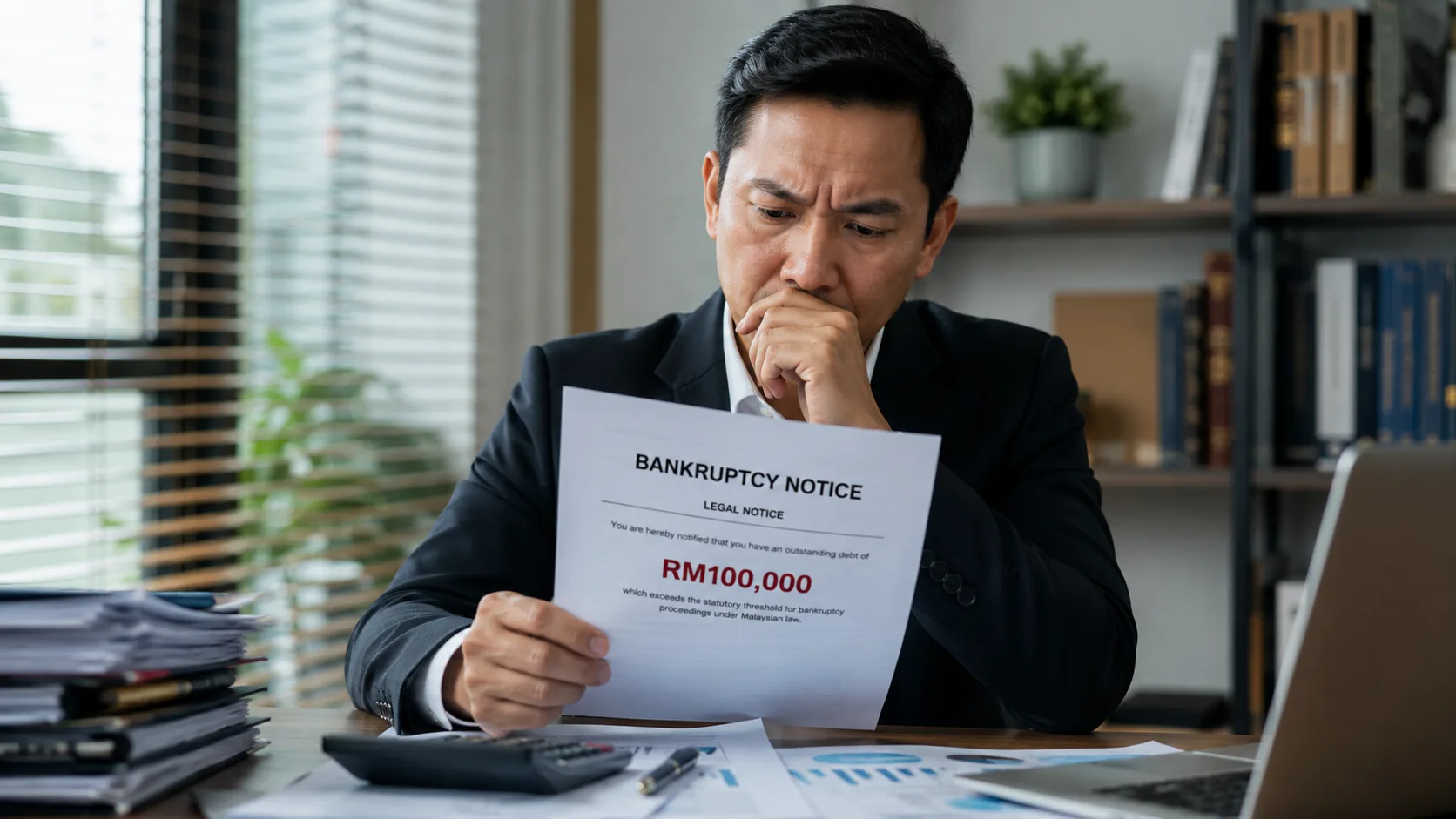
If you still do not pay, the bank may serve you with a bankruptcy notice.
A bankruptcy notice is not the same as a normal letter of demand.
It is a formal document under the Insolvency Act requiring you to deal with the judgment debt within a very short period.
If the notice is served on you in Malaysia, you generally have 7 days to act.
That may mean paying the debt, providing acceptable security, reaching an arrangement with the creditor, or taking the appropriate legal step if there is a genuine basis to challenge the notice. See our full guide to bankruptcy notices for how the 7-day deadline works and how a notice can be challenged.
Ignoring it can make matters much worse.
How can bankruptcy proceedings start?
There are two main ways.
1. A creditor applies to bankrupt you
This is the route most people think of.
The usual sequence is:
Court judgment, bankruptcy notice, failure to comply, creditor's petition, bankruptcy hearing.
The creditor cannot simply send you a letter and declare you bankrupt.
A bankruptcy petition must be filed in the High Court, and the court must be satisfied that the legal requirements have been met.
The creditor must prove the debt, the act of bankruptcy and the required service of documents.
Only the court can make a bankruptcy order.
2. You apply to bankrupt yourself
A person who cannot pay his or her debts may also file a debtor's petition.
There is no RM100,000 minimum threshold for this route.
This sometimes surprises people, because the RM100,000 rule applies to creditors who want to bankrupt someone, not to a debtor who applies personally.
Self bankruptcy should not be treated as an easy solution to financial problems. Bankruptcy comes with serious consequences affecting your assets, finances and freedom to deal with certain matters.
Anyone considering this option should first look at alternatives such as negotiation, restructuring or professional debt counselling.
What should you do if you receive a bankruptcy notice?
First, do not ignore it.
The deadline can be as short as 7 days.
Check the amount claimed, the judgment relied on, the date the notice was served and the deadline stated in the document.
Then work out whether the debt can be paid, secured or settled.
If there is a genuine legal problem with the notice or the debt, you may need to take immediate court action.
Timing matters because informal discussions with the creditor do not necessarily stop the legal deadline from running.
If you are unsure whether the document is a normal demand letter, a bankruptcy notice or a creditor's petition, get advice quickly. They are very different documents.
What if I dispute the debt?
A genuine dispute can affect bankruptcy proceedings.
But simply saying "I disagree with the debt" is not enough.
If there is already a final court judgment against you, you generally cannot use the bankruptcy process to reopen the entire original case just because you are unhappy with the result.
The court will look at whether there is a real legal basis for the challenge.
There may also be situations where you have a genuine claim against the creditor that could reduce or cancel the amount owed. The law contains rules dealing with this, but the facts must be examined carefully.
The important point is that a real legal dispute may matter. A bare denial usually does not.
Can the court refuse to bankrupt me?
Yes.
Even if a creditor has filed a petition, the court still has to decide whether a bankruptcy order should be made.
The court may dismiss the petition if the creditor fails to prove the necessary requirements.
The court may also refuse to make the order if you can show that you are able to pay your debts, or if there is another sufficient reason not to make the order.
This is why attending the hearing and preparing proper evidence is important.
If you have the financial ability to settle the debt, bank statements, available funds or other financial records may become relevant.
Can a guarantor be made bankrupt?
It depends on the type of guarantee.
The Insolvency Act gives special protection to a social guarantor.
A social guarantor is not simply anyone who guaranteed a loan for a friend or family member.
The definition covers specific categories, including certain guarantees for education loans, personal or non business vehicle hire purchase loans, and housing loans for personal occupation, where the guarantor did not receive a profit or benefit.
Bankruptcy action cannot be taken against a social guarantor.
Other guarantors do not receive the same automatic protection.
For a non social guarantor, the creditor generally has to obtain permission from the court before starting bankruptcy proceedings and show that other methods of recovering the money from the borrower have already been tried.
Can I be made bankrupt without knowing?
Normally, court documents have to be served on you.
But avoiding letters or refusing to accept documents is not a safe strategy.
If personal service is not possible, the court may allow another method of serving the documents.
This is sometimes called substituted service.
The practical point is simple: avoiding the creditor does not necessarily stop the proceedings.
Common bankruptcy myths
"Any unpaid debt can bankrupt me."
No.
A creditor generally needs to meet the RM100,000 threshold before filing a bankruptcy petition.
Smaller debts can still be recovered through other legal methods, but bankruptcy may not be available.
"A bank can bankrupt me immediately."
No.
A bank cannot simply declare you bankrupt.
There are legal steps that must be followed, and only the High Court can make a bankruptcy order.
"A bankruptcy notice means I am already bankrupt."
No.
A bankruptcy notice is a serious warning stage, but you are not bankrupt merely because one has been served.
The problem is that the deadline to respond is very short.
"Every guarantor is protected."
No.
The special protection applies only to social guarantors who fall within the legal definition.
What should you do if bankruptcy is being threatened?
Start by identifying exactly what stage the matter has reached.
If you have only received a letter of demand, there may still be room to negotiate before court proceedings begin.
If there is already a court judgment, the creditor may be moving towards enforcement.
If a bankruptcy notice has been served, the situation is more urgent because the 7 day period may already be running.
If a creditor's petition has been filed, you should understand when the hearing is and what grounds may realistically be available.
Where financial difficulties are genuine, dealing with the problem early usually gives you more options than waiting until the bankruptcy hearing.
Frequently Asked Questions
What is the minimum debt for bankruptcy in Malaysia?
For a creditor's petition, the current minimum debt is RM100,000.
There is no equivalent minimum for a person who files his or her own debtor's petition.
How long do I have after receiving a bankruptcy notice?
If the notice is served in Malaysia, the usual period is 7 days.
You should check the document immediately and get advice if you are unsure what to do.
Can two creditors combine their debts?
Yes.
If two or more creditors join together in the same petition, their debts may be added together to reach the RM100,000 threshold.
Can I be bankrupted for a debt I genuinely dispute?
A genuine legal dispute can affect the proceedings, but the position depends on the stage of the case.
If there is already a final court judgment, simply disagreeing with the debt is generally not enough.
Final takeaway
The RM100,000 threshold is an important protection, but it does not tell the whole story.
A creditor must still follow the Insolvency Act, establish the debt, rely on a valid act of bankruptcy and satisfy the court before a bankruptcy order can be made.
If you receive a bankruptcy notice or petition, do not assume that bankruptcy is inevitable.
But do not ignore it either.
The earlier you understand what stage the proceedings have reached, the more time you may have to consider payment, settlement, restructuring or a proper legal challenge.
Bankruptcy also does not necessarily last forever. If you are already bankrupt, see our guide on how to get out of bankruptcy in Malaysia for the three main discharge routes, and our guide to what you can and cannot do once the order has been made.
Speak to JPP LAW
JPP LAW assists clients with debt recovery, bankruptcy proceedings, bankruptcy notices, creditor's petitions, judgment enforcement and disputes involving unpaid debts in Malaysia.
If you have received a bankruptcy notice or petition, or you are a creditor considering bankruptcy proceedings against a debtor, you may contact us to discuss the legal position and available options.
Disclaimer: This article is for general information only and does not constitute legal advice. Bankruptcy proceedings depend on the amount and nature of the debt, the judgment obtained, service of documents, applicable deadlines and the specific facts of each case.
Your next step
Have a question about your own matter?
Speak directly with a partner about your situation. We will help you understand where you stand and what your options are, with no obligation.
Speak to a PartnerMore in Disputes & Litigation
Defamation vs Libel vs Slander in Malaysia: What's the Difference?
Defamation vs libel vs slander in Malaysia: learn the difference, what you must prove, online defamation rules, key defences, damages and time limits.
Read→My Tenant Stopped Paying Rent in Malaysia: What Can a Landlord Do?
Tenant stopped paying rent in Malaysia? Learn how landlords can recover arrears, use a writ of distress, regain possession and claim double rent lawfully.
Read→Bankruptcy in Malaysia: What You Can and Cannot Do After the Order
Declared bankrupt in Malaysia? Learn what happens to your property, whether you can work, travel, run a business, use a bank account and what you must do next.
Read→