
Disputes & Litigation
Bankruptcy in Malaysia: What You Can and Cannot Do After the Order
Written by Justin Yap, Partner
Last reviewed 22 August 2026 · 6 min read
On this page
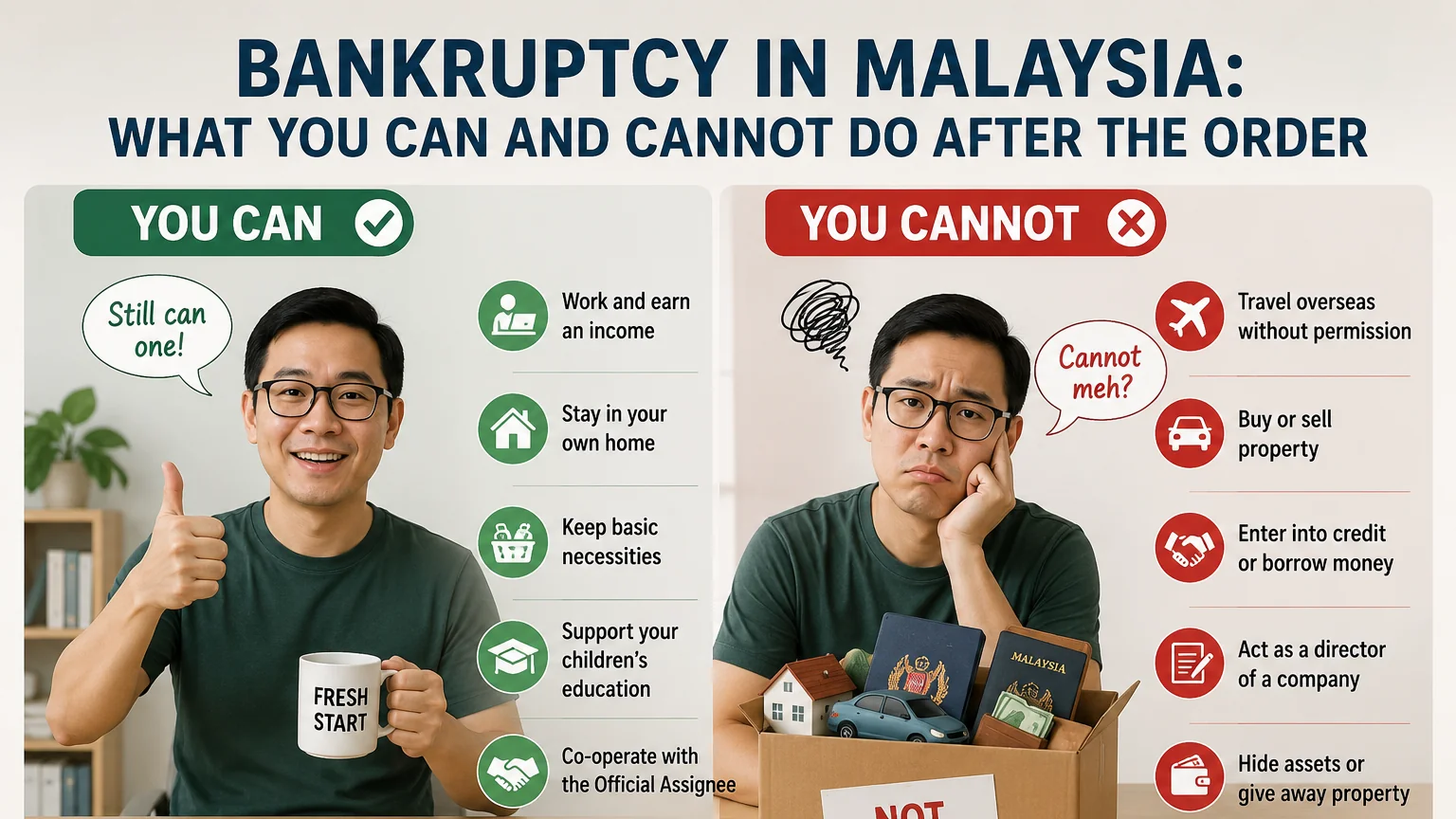
Being declared bankrupt does not mean your life stops. You can still work, earn an income and support your family, but there are important restrictions on your property, travel, business activities, bank accounts and certain legal proceedings.
Bankruptcy also changes how your creditors deal with you. Instead of every creditor separately pursuing the same debts, your financial affairs are generally administered through the Director General of Insolvency.
What happens immediately after you are made bankrupt?
Once the High Court makes a bankruptcy order, most of your property becomes part of your bankruptcy estate and is placed under the control of the Director General of Insolvency, commonly referred to as the DGI.
The DGI administers that property and, where appropriate, sells or deals with it so that money can be distributed among your creditors.
There are exceptions. Certain property held for someone else and limited basic necessities or tools used for work may be protected under the Insolvency Act 1967.
This does not mean someone arrives at your home the next morning and takes everything you own. But you should not sell, transfer or give away property that forms part of the bankruptcy estate without dealing with the DGI.
Bankruptcy also gives you some protection from creditors
There is another side to bankruptcy that people often overlook.
Once the bankruptcy order is made, creditors with debts that fall within the bankruptcy generally cannot continue taking legal action against you or your property for those debts without permission from the court.
Instead, they usually have to submit their claims through the bankruptcy process.
This gives the debtor a more structured system for dealing with multiple creditors.
However, the protection is not absolute. For example, a secured creditor may still have rights over the property given as security, such as a charged property.
So bankruptcy does not erase your debts immediately, but it changes how most creditors can pursue them.
Can you still work if you are bankrupt?
Yes.
Bankruptcy does not generally stop you from being employed.
You can continue your existing job or apply for a new one. The Malaysia Department of Insolvency also confirms that bankruptcy itself does not prevent someone from working.
Your income is not automatically taken away in full.
You still need money for reasonable living expenses for yourself and your family. However, depending on your circumstances, you may be required to contribute part of your income towards the bankruptcy estate.
Some jobs and professions have separate rules. For example, company directors and certain regulated professionals may face additional restrictions.
If your job is regulated by a professional body, check the rules that apply to that profession.
What must you do after being declared bankrupt?
You have legal duties once a bankruptcy order is made.
One of the most important is submitting your Statement of Affairs.
This is a formal document setting out your financial position, including your assets, debts and creditors.
If you filed for your own bankruptcy, it generally has to be submitted within 7 days from the bankruptcy order.
If a creditor made you bankrupt, the usual period is 21 days.
The DGI may extend the deadline for special reasons, but you should not assume an extension will automatically be given.
Submitting the Statement of Affairs is particularly important because it also affects the timing of your possible automatic discharge.
You must continue cooperating with MdI
Bankruptcy is not a situation where you file one form and then ignore the matter.
You must provide information requested by the DGI and assist with the administration of your property.
You are also required to provide an account of your money and property every 6 months and deal with any amount that is above what is reasonably needed to maintain yourself and your family.
If you receive money or property worth more than RM500 outside your usual income, you must report it to the DGI.
You must also inform the DGI if your home address changes.
Failing to comply with these duties can have serious consequences and may also affect how quickly you can eventually be discharged from bankruptcy.
Can you travel overseas?
Yes, but you need permission first.
An undischarged bankrupt cannot leave Malaysia without the previous permission of the DGI or the court.
You can apply for approval, including through the relevant MdI process.
MdI states that applications may be considered for reasonable purposes such as employment, medical treatment, religious matters or personal reasons.
Do not assume that buying an air ticket means you are allowed to travel.
The DGI can notify Immigration to stop a bankrupt from leaving Malaysia. An immigration officer may also seize the passport or travel document of a bankrupt who attempts to leave without permission.
The practical rule is simple: get approval before travelling.
Can you run a business?
Not without permission.
An undischarged bankrupt cannot start or carry on a business, either alone or in partnership, without the previous permission of the DGI or the court.
There are also restrictions on managing or controlling a business belonging to certain close family members, including a spouse, parent, child or sibling.
This does not mean entrepreneurship is permanently closed to you. It means you need approval while you remain an undischarged bankrupt.
If permission is granted, conditions may be imposed.
Can you still be a company director?
An undischarged bankrupt generally cannot act as a company director or take part directly or indirectly in managing a company without the necessary leave.
The Companies Act 2016 contains its own restrictions on undischarged bankrupts acting as directors.
So if you were already a director when the bankruptcy order was made, or you are considering becoming one, do not continue acting as though nothing has changed.
Check your position and obtain the required approval first.
Can you use a bank account?
Bankruptcy can affect your bank accounts.
MdI states that existing accounts may be closed or restricted after a person is declared bankrupt.
However, that does not mean you can never have a bank account again.
You can apply to the DGI for permission to open a new account or reactivate an existing account, for example to receive your salary or pay normal living expenses.
If approved, MdI can issue written permission for you to provide to the bank.
Can you borrow money?
There is another rule many people do not know about.
If an undischarged bankrupt obtains credit of RM1,000 or more, the bankrupt must disclose the bankruptcy status to the person providing the credit.
A bankrupt involved in an approved business must also disclose that status when entering into business dealings or contracts.
Failing to disclose your bankruptcy in these situations can amount to an offence.
Bankruptcy therefore does not necessarily prevent every financial transaction, but transparency becomes important.
Can you sue someone?
Generally, an undischarged bankrupt needs the DGI's approval before starting or continuing a court action.
There is an important exception for certain claims involving personal injury.
So if someone owes you money or you want to bring a commercial claim, you should first check whether the DGI's sanction is required.
Do not assume that being bankrupt means you have lost every legal right. The restriction mainly affects how those rights are exercised.
Do you lose your house and car automatically?
Not necessarily overnight, but property you own will generally need to be dealt with as part of the bankruptcy estate.
Your interest in a house, vehicle, investments or other valuable assets may be controlled or realised by the DGI for the benefit of creditors.
If the property is subject to a bank loan or other security, the secured creditor may also have separate rights over it.
Do not sell, transfer or place property in someone else's name in an attempt to keep it away from the bankruptcy process.
That can create much more serious problems.
Common myths about life after bankruptcy
"A bankrupt cannot work."
No. You can generally continue working and earning an income.
"A bankrupt can never travel again."
No. You can travel if permission is obtained from the DGI or court.
"Bankruptcy means I go to jail."
No. Bankruptcy itself is not a criminal punishment. However, dishonest conduct or failure to comply with certain legal duties can lead to separate consequences.
"I cannot have a bank account."
Not necessarily. You may apply to the DGI for permission to open or reactivate an account for legitimate purposes such as receiving your salary.
"My creditors can keep suing me."
Generally, creditors dealing with debts covered by the bankruptcy cannot simply continue legal proceedings without the court's leave. They usually have to participate in the bankruptcy process.
What should you do after a bankruptcy order?
Contact the MdI branch handling your case and make sure you understand what documents are required.
Submit your Statement of Affairs on time.
Keep your address and contact details updated. Provide your income and expenditure information when required and make the contributions assessed based on your circumstances.
If you need to travel, operate a business, become involved in company management, open a bank account or bring a legal claim, obtain the necessary permission first.
Most importantly, cooperate with MdI.
Cooperation matters because Malaysia now has several routes to discharge, including automatic discharge after the statutory requirements are met.
Frequently Asked Questions
Can I still work after being declared bankrupt?
Yes. Bankruptcy generally does not stop you from working, although some regulated professions and positions have additional restrictions.
Can I travel overseas?
Yes, but you must obtain permission from the DGI or the court before leaving Malaysia.
Can I start a business while bankrupt?
Only with the necessary permission. An undischarged bankrupt cannot simply start or carry on a business without approval.
Can I open a bank account?
You may apply to the DGI for permission to open or reactivate an account, including for salary and normal living expenses.
Final takeaway
Bankruptcy places real restrictions on your finances, property and certain activities, but it does not stop you from living or working.
You can continue earning an income, supporting your family and taking steps towards discharge.
The most important thing is to understand which activities require permission and to cooperate with the Malaysia Department of Insolvency.
Bankruptcy is a legal status that has to be managed carefully. It does not mean your working life or financial future is permanently over.
If you have received a bankruptcy notice and want to understand the process before it reaches this stage, see our guide to the 7-day deadline and how a notice can be challenged.
Speak to JPP LAW
JPP LAW assists clients with bankruptcy proceedings, discharge applications, bankruptcy notices, creditor disputes and related insolvency matters in Malaysia.
If you have recently been declared bankrupt and need to understand your rights, restrictions or options for discharge, you may contact us to discuss your position.
Disclaimer: This article is for general information only and does not constitute legal advice. The effects of bankruptcy depend on your assets, income, employment, business interests, court orders and the administration of your bankruptcy by the Malaysia Department of Insolvency.
Your next step
Have a question about your own matter?
Speak directly with a partner about your situation. We will help you understand where you stand and what your options are, with no obligation.
Speak to a PartnerMore in Disputes & Litigation
Defamation vs Libel vs Slander in Malaysia: What's the Difference?
Defamation vs libel vs slander in Malaysia: learn the difference, what you must prove, online defamation rules, key defences, damages and time limits.
Read→My Tenant Stopped Paying Rent in Malaysia: What Can a Landlord Do?
Tenant stopped paying rent in Malaysia? Learn how landlords can recover arrears, use a writ of distress, regain possession and claim double rent lawfully.
Read→Bankruptcy Notice in Malaysia: What to Do Within 7 Days
Received a bankruptcy notice in Malaysia? Learn what it means, the 7-day deadline, how it can be challenged and what happens if you ignore it.
Read→