
Construction
Pay-When-Paid Clauses in Malaysia: Are They Enforceable?
Written by Justin Yap, Partner
Last reviewed 17 September 2026 · 6 min read
On this page
If a qualifying construction contract was entered into on or after 15 April 2014, a clause making your payment dependent on your employer first being paid by someone else is generally void under section 35 of the Construction Industry Payment and Adjudication Act 2012.
A genuine certification requirement is different. A contract may still require an architect, engineer or other certifier to verify the work before payment becomes due, provided the clause is genuinely about assessing the work and not simply another way of saying, "You only get paid when we get paid."
What is a pay-when-paid clause?
Pay-when-paid clauses are common in construction chains involving an employer, main contractor and subcontractor.
A typical clause might say:
"The subcontractor will be paid within 7 days after the main contractor receives payment from the employer."
The practical effect is that the subcontractor carries the risk that the employer may never pay the main contractor.
Before CIPAA came into force, Malaysian courts generally recognised such clauses where the parties had clearly agreed to them.
CIPAA changed that position for contracts within its scope.
Section 35 provides that a conditional payment provision in a construction contract is void where payment depends on the paying party first receiving payment from a third party.
It also catches clauses where payment depends on the paying party having sufficient funds or obtaining financing.
The main contractor therefore cannot simply tell a subcontractor, "The employer has not paid us, so we do not have to pay you," if section 35 applies.
What types of clauses are caught?
The wording used in the contract is not the main issue. What matters is how the clause actually operates.
A clause is likely to fall within section 35 where it says payment will only be made:
- after the main contractor receives payment from the employer;
- on a "back-to-back" basis with payment from the employer;
- when funds become available;
- when a bank releases financing; or
- after a financing facility has been drawn down.
The common feature is that the contractor's or subcontractor's right to payment depends on an event outside its own performance of the work.
Section 35 removes that payment risk from the party lower down the construction chain.
When did the law change?
The date of the construction contract matters.
CIPAA came into operation on 15 April 2014.
In Jack-In Pile (M) Sdn Bhd v Bauer (Malaysia) Sdn Bhd [2020] 1 MLRA 259, the Federal Court held that CIPAA operates prospectively rather than retrospectively.
This means section 35 does not automatically invalidate a pay-when-paid clause contained in a construction contract entered into before CIPAA came into force.
Older contracts remain governed by the law that applied when those contractual rights were created. Earlier Malaysian cases such as Pernas Otis Elevator Co Sdn Bhd v Syarikat Pembenaan Yeoh Tiong Lay Sdn Bhd & Anor [2003] 4 MLRH 129 recognised the enforceability of clearly drafted conditional payment arrangements under the common law.
For any payment dispute involving an older project, the date of the contract should therefore be checked, alongside the other conditions that bring a contract within CIPAA, before assuming section 35 applies.
Does section 35 only apply during CIPAA adjudication?
No.
This is another common misunderstanding.
Section 35 is not merely a procedural rule that an adjudicator applies during a CIPAA claim. It affects the validity of the contractual provision itself.
In MN Global Venture Sdn Bhd v CB Bersatu Sdn Bhd [2022] MLRHU 850, the High Court held that section 35 has general application to qualifying construction contracts and is not confined to adjudication proceedings.
This means a party cannot rely on a prohibited pay-when-paid clause simply because the dispute has ended up in an ordinary court case rather than CIPAA adjudication.
If section 35 applies, the contractual condition itself is void.
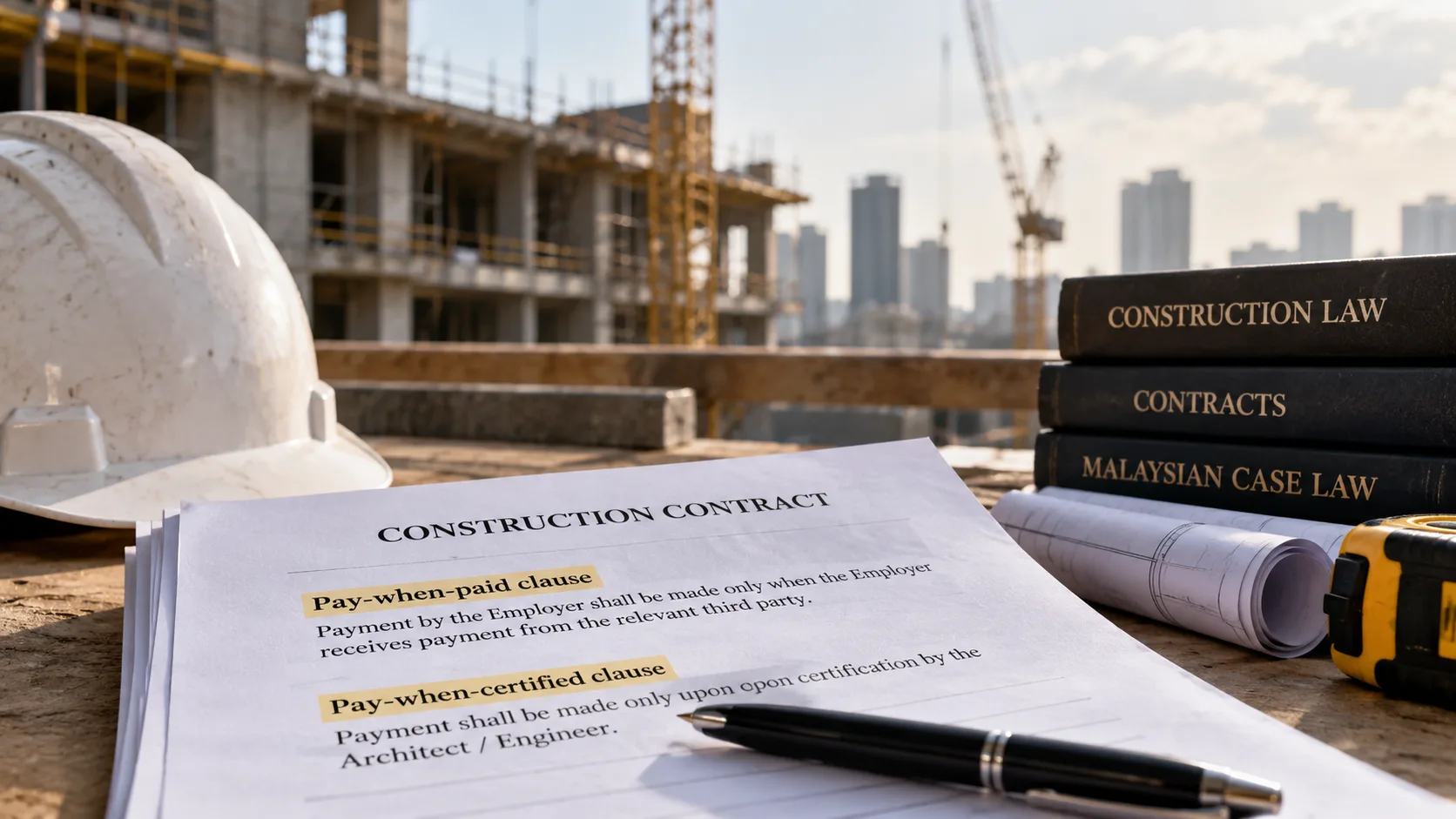
Pay-when-paid is different from pay-when-certified
This is the distinction that causes the most confusion.
A contract may say that payment becomes due only after the relevant work has been measured, verified or certified by an architect, engineer, Superintending Officer or another agreed certifier.
That type of requirement is not automatically prohibited by section 35.
The reason is that certification can serve a legitimate purpose. It determines whether the work has been carried out and how much should be paid.
The Court of Appeal addressed this distinction in Lion Pacific Sdn Bhd v Pestech Technology Sdn Bhd & Another Appeal [2022] 6 MLJ 967.
The subcontract required certification by the Ministry of Transport before payment became due. The Court of Appeal held that this was not a prohibited pay-when-paid arrangement because certification was being used to verify the work performed before payment arose.
CIPAA was not intended to remove genuine contractual mechanisms for measuring and certifying construction work.
The distinction can be summarised simply:
| Clause | Position under section 35 |
|---|---|
| "We will pay you when the employer pays us." | Generally void |
| "We will pay when our financing is released." | Generally void |
| "Payment is due after the architect certifies the work." | Not automatically void |
| Pay-when-paid clause in a contract made before 15 April 2014 | Section 35 does not apply retrospectively |
The substance of the clause still matters more than the heading used by the parties.
Why is certification treated differently?
Consider two examples.
A subcontractor completes RM500,000 worth of work.
Under the first clause, the main contractor says it only needs to pay the subcontractor after receiving RM500,000 from the employer.
That transfers the employer's non-payment risk directly to the subcontractor. Section 35 is designed to prevent that.
Under the second clause, an architect has to measure and certify how much work has actually been completed before payment is calculated.
That serves a different function. It establishes the value of the subcontractor's work rather than making payment depend on whether someone higher up the chain has paid.
The second type of clause may therefore remain enforceable.
However, describing something as "certification" does not automatically make it valid. If the clause is really designed to make payment depend on a third party paying the employer or main contractor, the court may look at its actual effect rather than the label used.
Can parties avoid section 35 by changing the wording?
They should not assume so.
Section 35 is concerned with conditional payment, not merely clauses containing the exact words "pay when paid".
For example, a clause saying that payment will only be made "subject to availability of funds" is expressly caught by section 35.
The same applies where payment depends on the drawdown of a financing facility.
Malaysian courts have also taken a broad approach to contractual mechanisms that improperly postpone payment.
In Econpile (M) Sdn Bhd v IRDK Ventures Sdn Bhd & Another Case [2017] 7 MLJ 732, the High Court considered a provision that postponed further payment following termination until completion and preparation of the final account. The court found that the provision operated as an impermissible conditional payment mechanism contrary to section 35.
The practical lesson is that changing the wording does not necessarily change the legal effect.
What happens when the clause is void?
Section 35 makes the conditional payment provision void. It does not automatically cancel the entire construction contract.
The parties must then look at the remaining payment provisions to determine when and how payment becomes due.
If the contract still contains a workable payment mechanism, those remaining terms may continue to govern the parties.
If there are no agreed payment terms, section 36 CIPAA provides default rules.
For construction work and consultancy services, the default frequency is monthly progress payment. The default due date is 30 calendar days from receipt of the invoice.
Section 36 should therefore be treated as a fallback where the parties have not agreed workable payment terms, rather than an automatic replacement for every clause struck down under section 35.
What should contractors and subcontractors check?
If payment is being withheld on a back-to-back basis, start with the wording of the contract.
Check when the contract was entered into and whether CIPAA applies to it. Then identify exactly what event supposedly has to occur before payment becomes due.
If the clause says that payment depends on the employer paying the main contractor, the availability of funds or financing, section 35 may render it void.
If the issue is instead that the work has not yet been certified, examine the certification clause carefully. The question may be whether certification was properly required and whether the certifier has acted in accordance with the contract. A withheld or disputed certification is also, at its core, a payment claim validity question, and a related deduction dressed up as certification should be tested the same way as any other set-off or backcharge.
These are legally different disputes. Whatever the answer, a contractor should be cautious about stopping work over a disputed conditional payment clause before that question has been resolved.
Frequently Asked Questions
Is a "back-to-back" payment clause valid in Malaysia?
If it means that one party only has to pay after receiving payment from a third party, it will generally be void under section 35 CIPAA where the Act applies.
Does section 35 apply to contracts signed before 15 April 2014?
No. The Federal Court in Jack-In Pile held that CIPAA applies prospectively. Older contracts must be considered under the law that applied when they were entered into.
Is a pay-when-certified clause automatically void?
No. A genuine certification requirement used to verify or value the work may remain enforceable. Lion Pacific confirms that certification and pay-when-paid are not the same thing.
Can I rely on section 35 without starting CIPAA adjudication?
Yes. Section 35 affects the validity of the contractual provision itself and is not confined to adjudication proceedings.
Final takeaway
For construction contracts within CIPAA, a party generally cannot make payment dependent on first being paid by somebody else, having enough money available or obtaining financing.
Certification is different. A genuine requirement for an architect, engineer or other certifier to verify completed work may remain valid because it determines whether and how much payment is due rather than shifting the risk of third-party non-payment.
The starting point in any dispute is therefore to check the contract date and read the payment clause carefully. The question is not simply whether the clause delays payment, but what event the payment actually depends on.
Speak to JPP LAW
Justin, Poh & Partners, also known as JPP LAW, assists employers, main contractors, subcontractors and consultants with construction payment disputes, conditional payment clauses, CIPAA adjudication, payment claims and construction litigation in Malaysia.
If payment is being withheld under a pay-when-paid, back-to-back or certification clause and you need to assess whether that clause is enforceable, you may contact us to discuss the contractual and statutory position.
Disclaimer: This article is for general information only and does not constitute legal advice. The enforceability of payment provisions depends on the date and wording of the construction contract, the nature of the certification or payment condition, and whether CIPAA applies to the particular arrangement.
Your next step
Have a question about your own matter?
Speak directly with a partner about your situation. We will help you understand where you stand and what your options are, with no obligation.
Speak to a PartnerMore in Construction
Back-to-Back Construction Contracts in Malaysia: What They Mean and What to Watch For
What is a back-to-back construction contract in Malaysia? Learn how obligations flow to subcontracts, key risks, CIPAA payment rules and clauses to check.
Read→Types of Construction Contracts in Malaysia: PAM, PWD, FIDIC, CIDB & IEM Explained
PAM, PWD or FIDIC? Compare construction contracts used in Malaysia, their project fit, design responsibility, risk allocation, CIDB and IEM alternatives.
Read→Wrongful Termination in Construction: How to Respond and What Can You Claim?
Was your construction contract terminated? Learn how to check if the termination was valid, what to do now and what damages you can claim.
Read→