Corporate
What Legal Documents Should a Startup Prepare Early?
Written by Justin Yap, Partner
Last reviewed 10 June 2026 · 6 min read
On this page
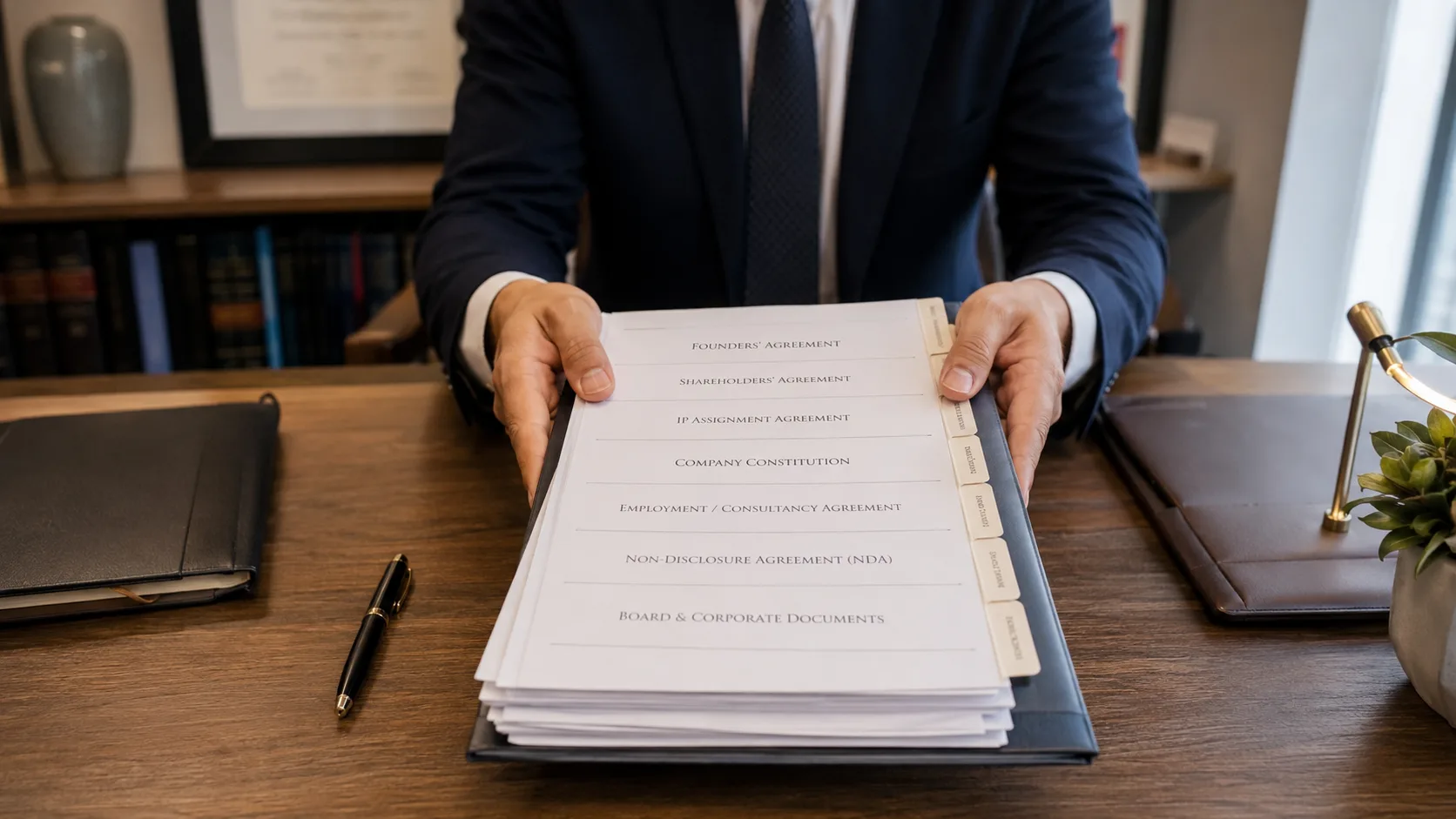
A startup in Malaysia should prepare its key legal documents early, including its founders' or shareholders' agreement, IP assignment documents, employment or contractor agreements, customer terms, privacy documents, and proper company records. These documents help prevent founder disputes, protect ownership of the business, support fundraising, and reduce legal risk before the company becomes valuable.
Most startup legal problems are not unusual. They often come from a small group of missing or weak documents. Founders move quickly, rely on trust, use templates, promise equity informally, hire people without clear terms, and assume that the company owns work created by founders, freelancers, or agencies.
Those gaps may not matter on day one. They become serious when the company raises investment, brings in a co-founder, loses a key employee, signs larger customers, enters a dispute, or prepares for due diligence.
The aim is not to bury the startup in paperwork. The aim is to put the right few documents in place early, while the founders are still aligned and the issues are easier to fix.
Founders' or shareholders' agreement
The most important early document for many startups is a founders' or shareholders' agreement. This agreement deals with the relationship between the people who own and control the company.
A good founders' agreement should cover ownership, decision-making, reserved matters, founder roles, share transfers, vesting, exit rights, confidentiality, intellectual property, non-solicitation, deadlock, and what happens if one founder leaves or stops contributing.
Without this document, founders may fall back on the company's constitution, the Companies Act 2016, and general law. Those frameworks may help, but they may not answer the practical questions that matter most to founders. For example, can an inactive founder keep all their shares? Who controls major decisions? What happens if the founders are deadlocked? How are shares valued if one founder exits?
These issues are much easier to agree on when everyone still trusts each other. Once the company has money, customers, investors, or real value, the same conversation becomes harder.
A founders' agreement turns future conflict into a process instead of a crisis.
Company constitution
Under the Companies Act 2016, a Malaysian company may or may not have a constitution. If a company does not have one, the default position under the Act applies. A constitution becomes useful where the founders want specific rules for how the company should be governed.
For startups, a constitution may be relevant where the company needs customised rights, share structures, decision-making rules, transfer restrictions, or governance arrangements. It should also be reviewed together with the shareholders' agreement so the documents do not contradict each other.
A constitution is not always the first document a founder thinks about, but it can become important once investors, different classes of shares, transfer restrictions, or more formal governance arrangements are introduced.
If the startup expects to raise funds, issue shares, or bring in different stakeholders, it is worth checking early whether the constitution is suitable for the company's intended structure.
IP assignment documents
Intellectual property is often one of the most important assets of a startup. This may include software code, product design, platform architecture, brand assets, logos, content, domain names, databases, user interface design, business materials, and technical documentation.
A common mistake is assuming that the company owns the IP simply because the work was created for the startup. That may not always be safe. If a founder created work before the company was incorporated, the company may need a written assignment. If a freelancer, developer, agency, designer, consultant, or contractor created work, the company should have written terms confirming ownership or usage rights.
This matters because investors and buyers will want to know whether the company owns what it is raising money on. If the company's product depends on code or branding that is not clearly assigned to the company, the issue can delay or damage fundraising.
An IP assignment should be clear on what is assigned, when the assignment takes effect, whether source files and editable files must be delivered, whether moral rights or similar issues need to be addressed where relevant, and whether the creator retains any licence or portfolio rights.
The company should own or properly control the assets it depends on.
Employment and contractor agreements
Startups often hire quickly. They engage employees, contractors, developers, designers, sales staff, interns, consultants, and advisers before the internal documents are ready. This creates risk.
Employment and contractor agreements should clearly deal with role, scope of work, payment, confidentiality, IP ownership, termination, return of company property, non-solicitation where appropriate, and access to company systems.
It is also important to distinguish employees from independent contractors. Labelling someone a contractor does not automatically make them one if the actual working relationship looks like employment. The wrong classification can create issues relating to statutory contributions, termination, benefits, and workplace obligations.
For contractors, the agreement should be especially clear on deliverables and IP ownership. For employees, the agreement should align with actual working arrangements and basic employment compliance.
As the startup grows, informal hiring becomes harder to manage. Clear documents help prevent disputes over pay, ownership, resignation, termination, confidentiality, and work product.
Customer terms and service agreements
Once a startup starts selling, it needs proper customer-facing documents. The form of document depends on the business model.
A software platform may need terms of service, privacy documents, acceptable use rules, subscription terms, refund terms, and limitation of liability clauses. A service business may need a service agreement, statement of work, payment terms, scope of services, timeline, variation process, and termination rights. A marketplace may need user terms, seller terms, platform rules, risk disclosures, and complaint processes.
Customer documents should not be copied blindly. The terms should reflect how the business actually operates, how payment is collected, what the customer receives, what the startup is responsible for, what it is not responsible for, and what happens if something goes wrong.
This is especially important where the startup handles payments, user content, digital assets, personal data, regulated services, professional services, subscriptions, refunds, delivery, or third-party providers.
Clear customer terms help reduce disputes and make the business look more credible during investor or partner review.
Non-disclosure and confidentiality documents
Startups often discuss ideas, technology, commercial plans, customer lists, pricing, financials, product roadmaps, and investor materials with third parties. Confidentiality should be handled carefully.
A non-disclosure agreement can be useful when sharing sensitive information with contractors, vendors, commercial partners, potential collaborators, or acquisition parties. It can also be relevant where technical information, trade secrets, pricing, or business strategy is being disclosed.
However, founders should be realistic. Some investors may not sign an NDA at the early pitch stage. In that situation, the startup should control what it discloses, avoid sharing highly sensitive material too early, and keep a record of what was shared and with whom.
Confidentiality should also be built into employment, contractor, founder, and commercial agreements. A standalone NDA is useful in some situations, but it should not be the only protection.
The better approach is to control access, document sensitive disclosures, and ensure the right confidentiality wording exists in the key relationships.
Privacy policy and data handling documents
If a startup collects or processes personal data in commercial transactions, Malaysian personal data protection obligations may apply. Personal data may include names, phone numbers, email addresses, identity details, payment information, location data, account information, or customer records.
A privacy notice or privacy policy should explain what data is collected, why it is collected, how it is used, who it may be shared with, how long it is kept, and how individuals may exercise their rights. The startup should also think about consent, security, access control, vendor arrangements, data retention, and internal handling of customer data.
This matters even for small startups. Many early-stage businesses collect data through websites, forms, WhatsApp, CRM tools, payment platforms, booking systems, marketplaces, or app onboarding flows.
Data issues become harder to fix later when the product has more users, more vendors, more staff, and more integrations. Privacy documents should therefore be prepared early, especially for startups that depend on user data.
Corporate records and resolutions
A startup should keep proper company records from the beginning. This includes share records, director and shareholder information, resolutions, approvals, share issuance documents, share transfer documents, appointment and resignation records, and other statutory or corporate documents.
Poor records can cause serious problems during fundraising. Investors will usually want to see the cap table, share issuance history, board approvals, shareholder approvals, company information, and records showing that key decisions were properly made.
If the records are incomplete, founders may need to clean them up under deal pressure. This can delay the round and reduce investor confidence.
Good corporate records also help prevent internal disputes. If shares were issued, approvals were passed, directors were appointed, or major contracts were approved, the company should be able to show it clearly.
A startup should not wait until due diligence to organise its own company records.
Templates are a starting point, not the final answer
Templates can be useful for founders who are trying to understand what documents they need. The risk is treating templates as finished documents.
A template is written for nobody in particular. It may not reflect the startup's business model, shareholding structure, founder dynamics, IP position, customer journey, revenue model, liability risk, regulatory exposure, or data practices.
This is most dangerous for shareholders' agreements, IP assignments, customer terms, privacy documents, and investment-related documents. These documents should match the actual business.
A bad template can be worse than no document because it gives founders false confidence. They may assume the issue is covered when the wording does not actually protect them.
The key documents should be tailored once the startup has real founders, real customers, real staff, real technology, or real fundraising plans.
Frequently Asked Questions
What legal documents should a startup prepare early in Malaysia?
A startup should usually prepare a founders' or shareholders' agreement, IP assignment documents, employment and contractor agreements, customer terms, confidentiality documents, privacy documents, and proper corporate records. The exact documents depend on the business model, ownership structure, staff, customers, and regulatory risks.
What is the most important legal document for a startup?
For many startups, the most important document is the founders' or shareholders' agreement because it deals with ownership, control, decision-making, vesting, deadlock, and exit. These are the issues most likely to cause serious founder disputes if they are not agreed early.
Does a Malaysian company need a constitution?
A Malaysian company may or may not have a constitution under the Companies Act 2016. If there is no constitution, the company generally relies on the default framework under the Act. A constitution is useful where the founders want specific governance rules, share rights, transfer restrictions, or decision-making arrangements.
Final takeaway
A startup does not need a large pile of legal documents at the beginning. It needs the right documents, prepared clearly and early.
The key documents usually include a founders' or shareholders' agreement, IP assignment documents, employment and contractor terms, customer terms, confidentiality documents, privacy documents, and proper company records. These documents help prevent disputes, support fundraising, protect ownership, and make the business easier to grow.
Speak to JPP LAW
Justin, Poh & Partners, also known as JPP LAW, assists clients with corporate advisory, commercial contracts, company structuring, shareholder arrangements, startup documents, contractual claims, settlement negotiations, and civil or commercial disputes in Malaysia. If you are setting up a startup, preparing for fundraising, or tidying up your company documents, you may contact us to discuss the matter.
Disclaimer: This article is for general information only and does not constitute legal advice. You should seek advice based on your specific facts and documents.
Your next step
Have a question about your own matter?
Speak directly with a partner about your situation. We will help you understand where you stand and what your options are, with no obligation.
Speak to a PartnerMore in Corporate
Sole Proprietor vs Sdn Bhd in Malaysia: Which Should You Choose?
Sole proprietor or Sdn Bhd in Malaysia? Compare personal liability, costs, ownership, tax, compliance and growth before choosing your business structure.
Read→Directors' Duties and Personal Liability in Malaysia: What Every Director Must Know
Can a company director be personally liable in Malaysia? Learn directors' duties, fraudulent trading and corporate veil rules in Malaysia.
Read→What Is a Shareholders' Agreement in Malaysia and Why Does It Matter?
What is a shareholders' agreement in Malaysia? Learn how it protects founders and investors and how it differs from a company constitution.
Read→